
Wake County Land Property Records
Wake County property records are managed by the Register of Deeds office in Raleigh, the state capital. As the most populous county in North Carolina with over one million residents, Wake County processes a high volume of property transactions each year. The Register of Deeds maintains deeds, deeds of trust, plat maps, liens, and other land instruments. Wake County also offers robust online tools including BooksWeb for document searches and iMaps for GIS-based parcel viewing. These systems run around the clock and are free to use.
Wake County Quick Facts
Wake County Register of Deeds
The Wake County Register of Deeds office is located at 300 S. Salisbury Street in Raleigh, NC 27601. The office is open Monday through Friday from 8:00 AM to 5:00 PM, with document recording accepted until 4:30 PM. You can reach the office by phone at 919-856-5460.
Wake County was formed in 1771 from Orange and Johnston Counties. Property records here span more than 250 years. The Register of Deeds records and indexes all instruments related to real property including deeds, deeds of trust, liens, plat maps, powers of attorney, and court orders. The office also handles vital records, DD-214 military discharge papers at no charge, and passport services. Staff members can help you locate documents during business hours.
The NC Association of Register of Deeds maintains a statewide directory that includes the Wake County office and contact information for all 100 counties.
Wake County BooksWeb Property Records
Wake County operates the BooksWeb system for online property record searches. This tool is available 24 hours a day, seven days a week. It is free to use.
The BooksWeb interface allows searches by several criteria.
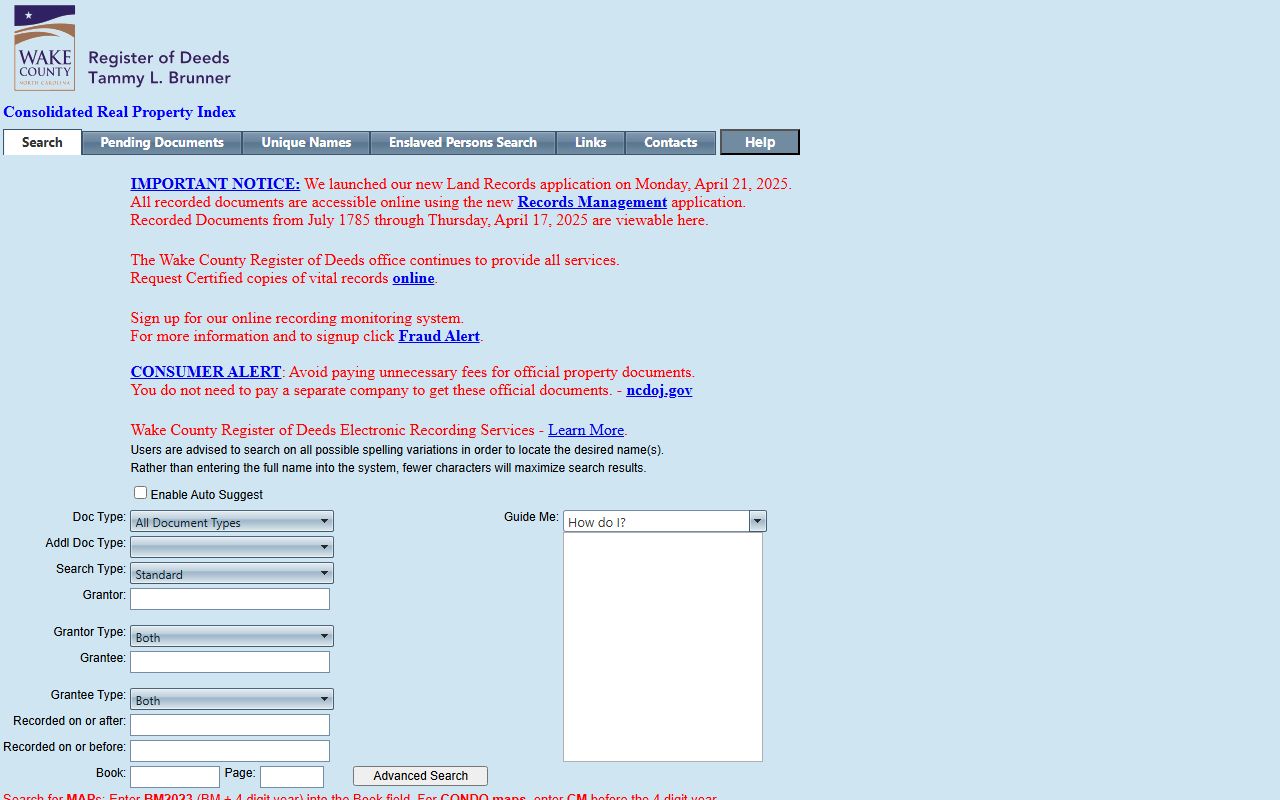
Access Wake County BooksWeb to search recorded documents by grantor, grantee, instrument number, book and page, date range, or legal description.
BooksWeb returns document images that you can view on screen. You can print copies or save them for your records. The system covers recorded instruments going back many years. For researchers, title searchers, and anyone who needs to verify property ownership in Wake County, BooksWeb is the primary online tool. It is considered one of the best public records search systems in the state. Wake County also supports eRecording, which allows title companies and attorneys to submit documents electronically rather than delivering them in person.
Wake County iMaps GIS System
Wake County's iMaps is an advanced GIS mapping system. It serves as a model for other counties across the state. The system displays parcel boundaries, ownership data, zoning, and other layers on an interactive map.
You can search iMaps by address, owner name, or parcel identification number. Click on any parcel to view details including the owner's name, acreage, assessed value, and building information. Aerial photography layered on the map shows current conditions of the land and any structures. The system also includes flood zone data, school districts, and municipal boundaries. For buyers, sellers, and researchers working in Wake County, iMaps provides a visual way to understand property details that supplements the recorded documents available through BooksWeb.
Wake County Tax Records
The Wake County Tax Administration office assesses all real property and collects property taxes. Tax bills are mailed in July or August each year. Taxes are due September 1 and become delinquent on January 6 of the following year.
Wake County completed a revaluation effective in 2024. During revaluation, the tax office adjusts assessed values to reflect current market conditions as required by N.C.G.S. Chapter 105. Property owners can appeal their new values if they believe the assessment does not reflect fair market value. The tax office provides forms and instructions for the appeal process.
Wake County offers tax relief programs for qualifying residents. These include exemptions and deferrals for elderly homeowners, disabled individuals, and veterans. Information about eligibility and application forms is available through the tax office. Unpaid property taxes result in a lien on the property, which is a matter of public record.
Wake County Recording Fees
The fee schedule at the Wake County Register of Deeds follows state guidelines. Understanding these costs helps you plan ahead before recording a document or ordering copies.
- Certified copies cost five dollars for the first page and two dollars for each additional page
- Uncertified copies cost twenty-five cents per page
- Excise tax is one dollar per five hundred dollars of the sale price
- DD-214 military discharge recordings are free
- eRecording is available for electronic submissions
These fees apply to all documents recorded at the Wake County Register of Deeds. The excise tax is paid by the seller at closing and is stamped on the deed. This tax provides a way to estimate the sale price of any property by reviewing the recorded deed in Wake County.
Property Records Title Search
A title search in Wake County traces ownership from the current owner back through prior deeds. Title searchers use the grantor and grantee indexes and the BooksWeb system to build this chain. They check for liens, judgments, easements, and other encumbrances that could affect the property.
North Carolina's Marketable Title Act establishes that a 30-year chain of title is generally sufficient. Older claims that were not preserved in the records may no longer apply. Given the volume of transactions in Wake County, thorough title searches are especially important. Properties may have changed hands many times, and each transfer must be verified. All recorded instruments must meet the requirements of N.C.G.S. Chapter 47, including proper notarization and a return address on the first page.
North Carolina State Resources
State agencies offer records and tools that complement Wake County property records.
The North Carolina State Archives in Raleigh holds early land grants and colonial-era records. Because Wake County is home to the state capital, many of these resources are located just minutes from the Register of Deeds office. The Secretary of State maintains business filings and UCC liens that may affect real property. Chapter 161 of the General Statutes governs Register of Deeds offices statewide, and Wake County follows these standards closely.
Nearby Counties
These counties border Wake County. Confirm your property's location before searching records.