
Raleigh Property Records
Raleigh property records are filed at the Wake County Register of Deeds. Raleigh is the state capital and the county seat of Wake County. The Register of Deeds office at 300 S. Salisbury St handles all deed recordings, lien filings, and plat recordings for properties in Raleigh. Wake County has over 1.1 million residents, and Raleigh is its largest city. Property records for the city date back to 1771 when the county was formed.
Raleigh Quick Facts
Raleigh Property Records at the Register of Deeds
The Wake County Register of Deeds records all property documents for Raleigh. This includes deeds, deeds of trust, liens, plats, and other instruments that affect real property. The office is in downtown Raleigh and serves the entire county. Staff can help you find recorded documents and get copies.
| Office | Wake County Register of Deeds |
|---|---|
| Address | 300 S. Salisbury St Raleigh, NC 27601 |
| Phone | (919) 856-5460 |
| Hours | Monday through Friday, 8:00 AM to 5:00 PM |
The office processes a large number of recordings each year. Raleigh is growing fast. New homes, commercial buildings, and subdivisions all create property records. The Register of Deeds records each document and assigns it a book and page number. This creates a permanent public record of the transaction. Anyone can search these records at no cost.
How to Search Raleigh Property Records
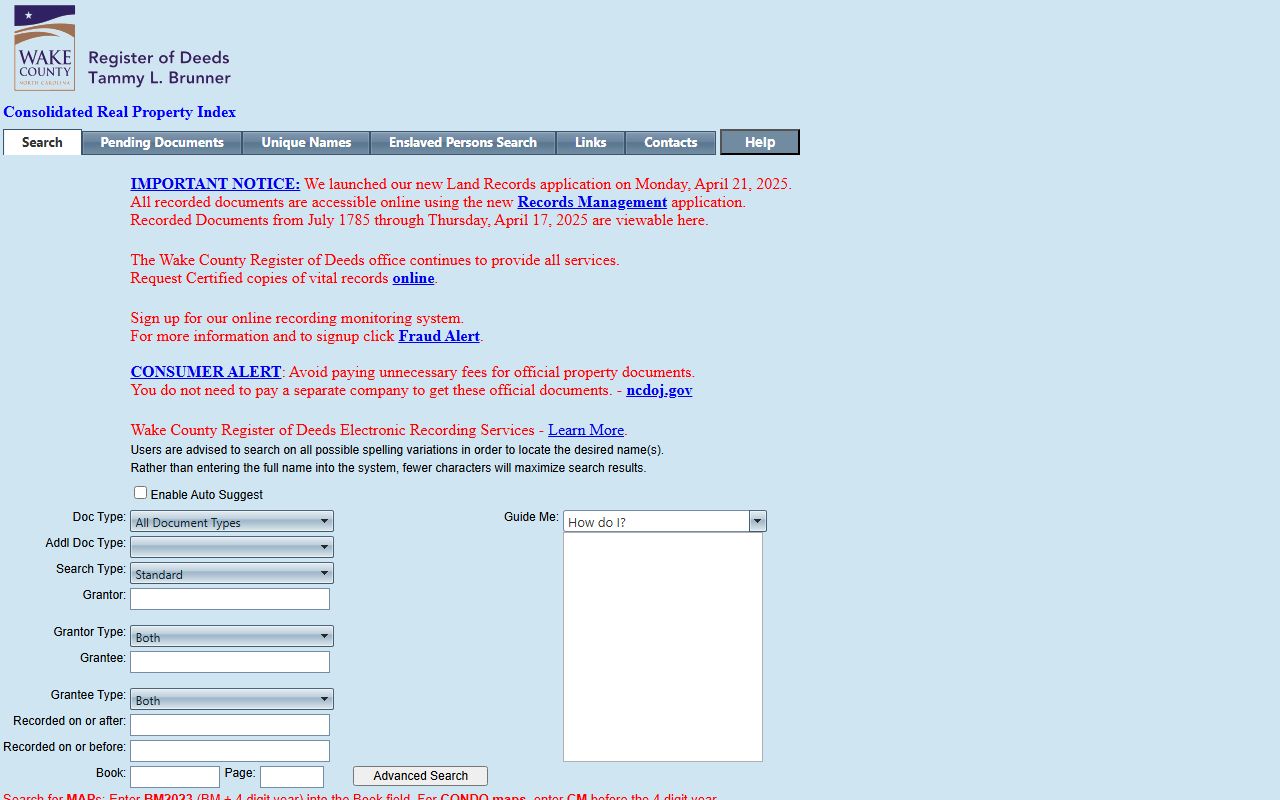
Wake County offers BooksWeb for online property record searches. BooksWeb is available 24 hours a day, 7 days a week. You can search recorded documents by grantor name, grantee name, book and page, or recording date. The system covers years of recorded documents for Raleigh and all of Wake County.
BooksWeb is free to use. You can view document images right on your screen. Many people use it to look up a deed before a closing or to check for liens on a property. The system is straightforward. Enter a name or parcel details and it returns matching records. You can then click any result to see the full document image. This saves a trip to the office for most basic searches of Raleigh property records.
The image below shows the Wake County BooksWeb interface used for Raleigh property searches.
Wake County also provides iMaps, an interactive GIS mapping tool. With iMaps you can click any parcel in Raleigh to see ownership, tax value, lot size, and zoning. The map layers include flood zones, soil types, and municipal boundaries. This makes iMaps useful for both casual lookups and in-depth research on Raleigh properties.
Raleigh Deed Records
Deeds are the core of property records in Raleigh. Every sale, gift, or transfer of real property creates a new deed. The deed names the parties, describes the property, and states the type of transfer. Once recorded at the Wake County Register of Deeds, the document becomes part of the public record.
Common deed types in Raleigh include general warranty deeds, special warranty deeds, and quitclaim deeds. A general warranty deed gives the buyer the strongest protection. It promises that the seller has clear title and the right to sell. Special warranty deeds limit that promise to the time the seller owned the property. Quitclaim deeds offer no warranty at all. They are often used between family members or to clear up title issues in Raleigh.
Every deed recorded in Raleigh shows revenue stamps. These stamps reflect the excise tax paid on the transfer. North Carolina charges this tax on most property sales. The amount of the tax tells you the approximate sale price. Researchers and appraisers use revenue stamps to track market values across Raleigh neighborhoods like downtown, North Hills, and Cameron Village.
Property Liens in Raleigh
Liens are recorded against Raleigh properties for many reasons. A deed of trust secures a mortgage loan. Tax liens arise from unpaid property taxes. Mechanic's liens come from unpaid construction work. Judgment liens result from court orders. All of these are filed at the Wake County Register of Deeds.
Before buying property in Raleigh, a title search checks for all recorded liens. A clear title means no outstanding claims exist against the property. Title companies in Raleigh run these searches as part of every real estate closing. If a lien shows up, it must be resolved before the sale can close. Most mortgage lenders in Raleigh also require title insurance to protect against any liens that might have been missed during the search.
Raleigh Property Tax Records
Wake County handles tax assessment for all properties in Raleigh. Tax records show the assessed value, the tax rate, and payment status. You can look up tax records through the county tax office website or through iMaps. These records are public.
Raleigh property owners pay both Wake County and City of Raleigh taxes. The combined rate is set each year during the budget process. Property values are reassessed on a regular schedule as required by Chapter 105 of the NC General Statutes. Owners who disagree with their assessed value can file an appeal with the county. The appeal must be filed within the deadline shown on your tax notice. Unpaid taxes result in a lien on the property and can lead to foreclosure.
Recording Documents in Raleigh
You can record property documents in Raleigh by visiting the Wake County Register of Deeds in person or through eRecording. Electronic recording is available for most document types. Title companies and attorneys in Raleigh use eRecording for faster turnaround on real estate transactions. Walk-in recording is also available during office hours.
Recorded documents must meet format standards set by North Carolina law. Requirements include proper margins, legible text, and correct notarization. Documents that do not meet standards will be returned. The Register of Deeds collects recording fees and excise taxes at the time of filing. Fee amounts are set by Chapter 161 of the General Statutes. Call the office at (919) 856-5460 to confirm current fees before you submit documents for recording in Raleigh.
Historical Property Records in Raleigh
Raleigh property records date to 1771 when Wake County was established. The earliest records cover land grants and early settlements in the area. Raleigh was founded in 1792 as a planned city to serve as the state capital. Property records from that era document the original lot sales and the growth of the city center.
The NC State Archives holds many early Wake County records. These include original deeds, wills, and estate records that mention property in Raleigh. The Register of Deeds office has an unbroken chain of recorded documents from the county's formation to the present day. Researchers, genealogists, and title examiners use these historical records regularly. The NC Association of Registers of Deeds provides guidance on locating older documents across the state.
Raleigh Plats and Survey Records
Plats are maps that show property boundaries. They are recorded at the Wake County Register of Deeds along with deeds and other documents. Every new subdivision in Raleigh requires a recorded plat. The plat shows lot lines, street layouts, easements, and other features. Buyers use plats to see the exact shape and size of a lot before purchasing.
Survey records help resolve boundary disputes in Raleigh. When two neighbors disagree about a property line, a licensed surveyor measures the land. The survey may reference recorded plats and deeds. Some older Raleigh neighborhoods have plats from the early 1900s that use landmarks as reference points. Modern surveys use GPS coordinates for higher accuracy. Both old and new plats are available through the Register of Deeds office and the BooksWeb online system.
Wake County Property Records
Raleigh is the county seat of Wake County. All property document recordings for Raleigh go through the Wake County Register of Deeds. The county serves Raleigh and many other municipalities including Cary, Apex, and Holly Springs. For full details on the county office, fees, and additional resources, visit the Wake County property records page.