
Tyrrell County Recorded Property Records
Tyrrell County property records are kept by the Register of Deeds in Columbia, North Carolina. As the least populated county in North Carolina, Tyrrell County holds a compact but historically rich collection of land documents. The Register of Deeds records and indexes all real estate transactions in the county. Public access is available at the courthouse in Columbia. These records include deeds, liens, plats, and other instruments that trace ownership of land along the Albemarle Sound and the surrounding coastal plain.
Tyrrell County Quick Facts
Tyrrell County Register of Deeds
The Tyrrell County Register of Deeds office operates from the courthouse in Columbia. This small office is the official repository for all recorded land documents in the county. Staff record deeds, deeds of trust, plats, liens, and other instruments. Each document is indexed by name and type so the public can search the records.
Tyrrell County was formed in 1729, making it one of the oldest counties in North Carolina. It sits on the eastern shore of the Albemarle Sound in the coastal plain. The county covers about 390 square miles, much of it wetlands, swamp, and forest. Pocosin Lakes National Wildlife Refuge and large tracts of managed timberland dominate the landscape. Private land holdings are relatively few compared to larger counties, which means the volume of property records is smaller but no less important.
The North Carolina Association of Register of Deeds maintains a statewide directory of county offices. You can find the Tyrrell County office address, phone number, and hours through this resource.
The statewide directory for locating Register of Deeds offices is shown below.
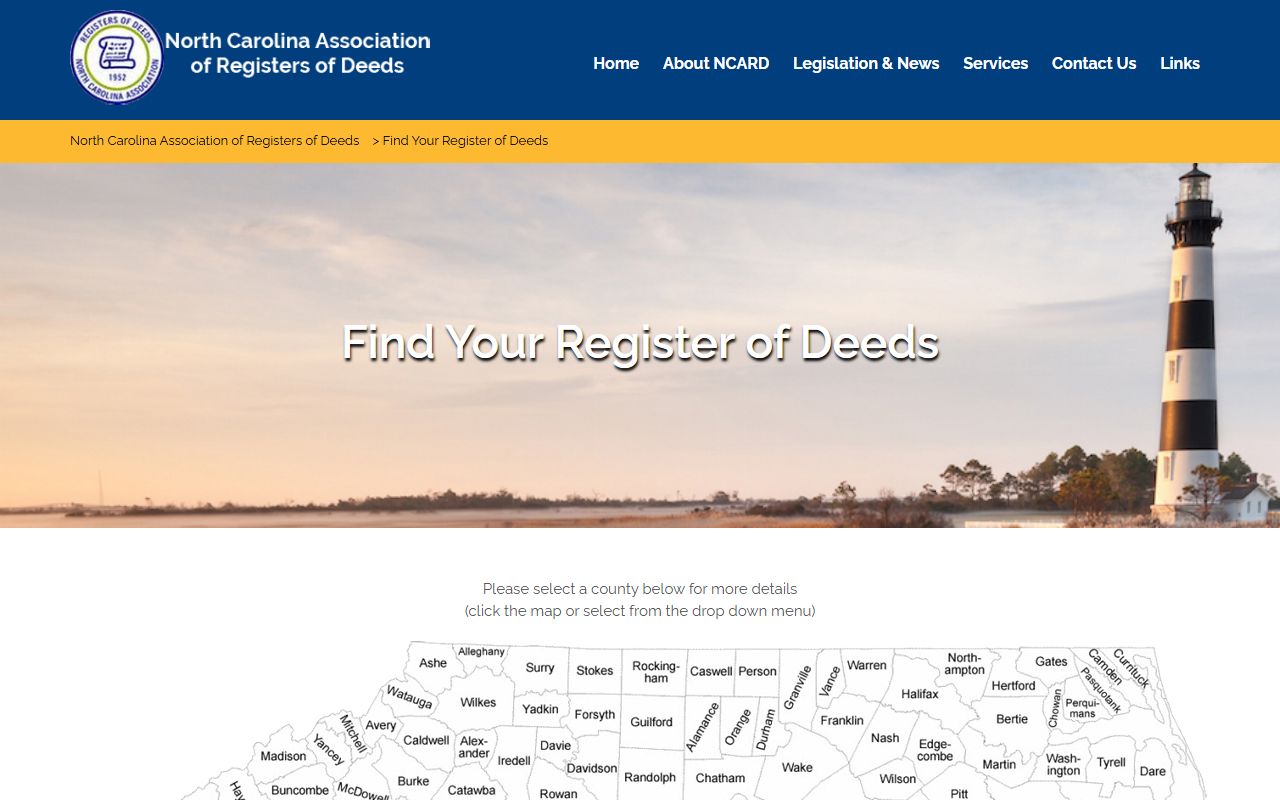
Use this directory to find contact details for the Tyrrell County Register of Deeds.
Searching Tyrrell County Land Records
Property record searches in Tyrrell County start at the Register of Deeds office in Columbia. The grantor index lists those who sold or transferred property. The grantee index lists those who received it. Search by name to find transfers for a specific person or entity.
For a title search, begin with the grantee index and work backward through each prior owner. This builds the chain of title. Each deed should connect to the one before it. Breaks in the chain need to be resolved. In Tyrrell County, where the population is small, land records tend to involve a smaller number of families and entities. This can make searches more straightforward, though older records may be harder to read due to their age.
Under N.C.G.S. Chapter 161, the Register of Deeds must maintain accurate indexes. Tyrrell County follows these requirements. The indexes stretch back to the county's formation in 1729, though the oldest records may be in fragile condition.
Types of Tyrrell County Property Records
Warranty deeds are the standard deed type in Tyrrell County. They transfer full ownership with a guarantee of clear title. Quitclaim deeds transfer whatever interest the grantor holds without warranties. These appear frequently in family transfers and estate settlements.
Deeds of trust secure loans on real property. North Carolina uses deeds of trust rather than mortgages. The borrower transfers the property to a trustee as security for the lender. When the debt is satisfied, a cancellation is recorded. If the borrower defaults, the trustee may sell the property following state foreclosure procedures.
Other recorded documents in Tyrrell County include:
- Tax liens from unpaid property taxes
- Mechanic's liens filed by contractors
- Judgment liens from court orders
- Plats and maps showing lot boundaries
- Easements for road access and utilities
All of these attach to the property and remain on record until released or satisfied.
Recording Documents in Tyrrell County
Recording a document in Tyrrell County requires meeting the standards of N.C.G.S. Chapter 47. The document must be signed, notarized, and include a return address on the first page. The grantor's name must match the prior recorded deed. Documents that do not meet these requirements may be rejected.
Recording fees and the excise tax on property transfers are due at the time of filing. The excise tax is one dollar per five hundred dollars of sale price, as set by N.C.G.S. Chapter 105. Both must be paid before the document is recorded and indexed.
The North Carolina statutes that govern recording are shown below.
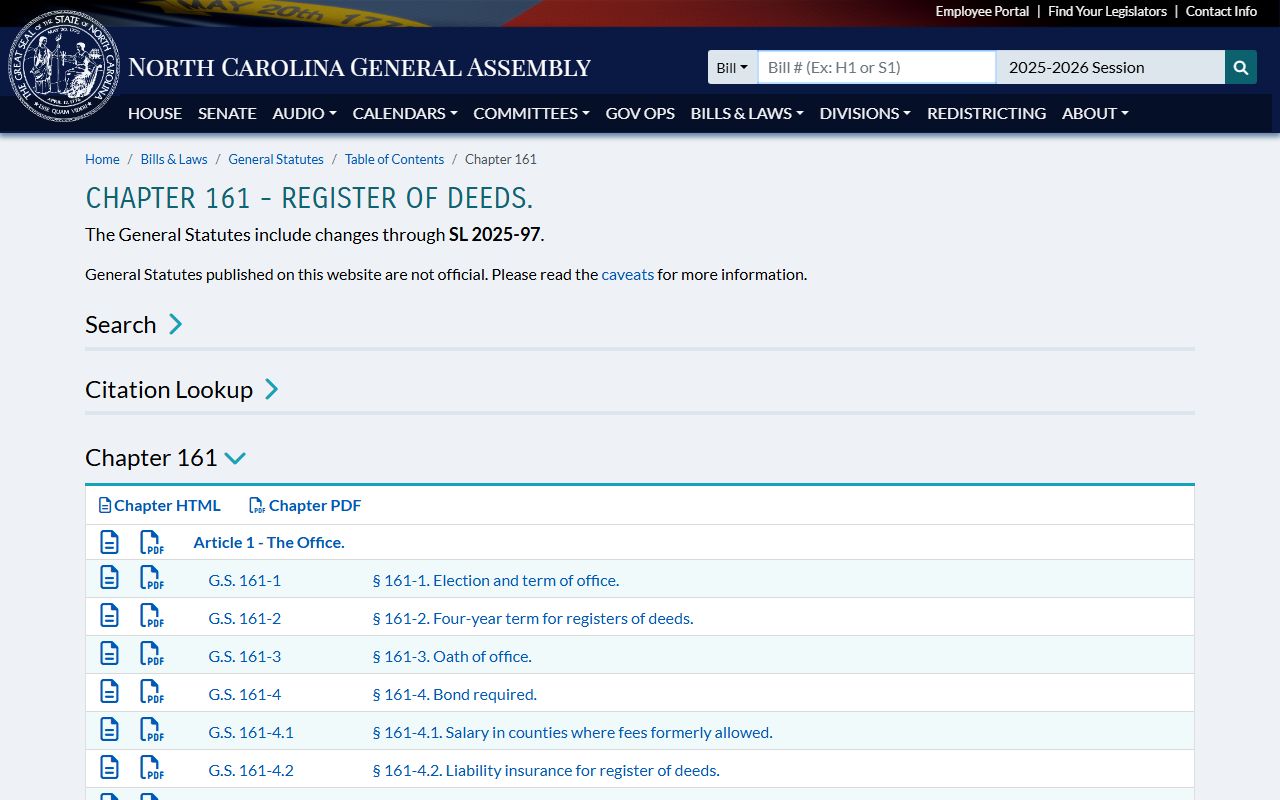
These statutes set the rules Tyrrell County follows for all recorded property documents.
Tyrrell County Title Research
Title research in Tyrrell County means tracing ownership from the current holder back through every prior transfer. The search covers deeds, deeds of trust, liens, judgments, easements, and covenants. A complete chain of title confirms that ownership has passed properly at each step.
The Marketable Title Act limits most searches in North Carolina to 30 years. Older claims not re-recorded may be extinguished. This law protects buyers and lenders in Tyrrell County who rely on the recorded chain of title.
Coastal plain land in Tyrrell County can have special title concerns. Some parcels border wetlands or waterways where boundaries shift over time. Older deeds may describe land by reference to creeks, canals, or ditches that have been altered. A surveyor familiar with the coastal terrain can help match old descriptions to current conditions. Large tracts held by timber companies or conservation groups may also have complex title histories that require careful research.
Historical Property Records
Tyrrell County is one of North Carolina's oldest counties. Its records reach back nearly three hundred years. Early land grants from the colonial period are part of the county's history. The land along the Albemarle Sound attracted settlers who farmed, fished, and harvested timber. Many of these early families held the same land for generations, and their transfers are reflected in the county records.
The North Carolina State Archives holds colonial-era land grants and older documents tied to Tyrrell County. Researchers can access these records in Raleigh. Some have been digitized. For parcels with roots in the 1700s, the State Archives is often the best starting point.
The North Carolina Secretary of State maintains business entity records that can help when property in Tyrrell County is held by a company, trust, or LLC. This is especially relevant for the large timber and conservation tracts in the county.
Tyrrell County Tax Property Records
The Tyrrell County tax office maintains assessed values and payment records for all parcels. Tax records show the appraised value, the tax rate, and whether taxes are current. Unpaid taxes lead to liens that attach to the property.
North Carolina requires revaluations at least every eight years. Tyrrell County follows this cycle. In a county with a small population and large tracts of rural land, assessed values tend to be lower than in more urbanized areas. Still, buyers should always check the tax records alongside the deed records before purchasing property. This ensures a complete understanding of the property's value, ownership, and any outstanding obligations.