
Surry County Property Records
Surry County property records are maintained by the Register of Deeds in Dobson, North Carolina. This northern Piedmont county borders Virginia and holds land documents that stretch back to the colonial period. The Register of Deeds records and indexes all real estate transactions for the county. Residents and the public can search deeds, liens, plats, and other instruments at the courthouse in Dobson. Surry County is home to Mount Airy, and the mix of town properties and rural mountain land gives the county a diverse set of property records.
Surry County Quick Facts
Surry County Register of Deeds
The Surry County Register of Deeds office is located in the courthouse in Dobson. This is the official repository for all land records in the county. Staff record deeds, deeds of trust, plats, liens, and other real estate instruments. Each document is indexed by grantor, grantee, date, and type. The office serves anyone who needs to search or record a land document in Surry County.
Surry County was formed in 1771. It once covered a much larger area that included parts of present-day Stokes, Yadkin, and Forsyth counties. Today it covers about 538 square miles along the Virginia border. The landscape varies from the rolling Piedmont in the south to the foothills of the Blue Ridge in the north. Mount Airy is the largest city and a center of commerce. Pilot Mountain, a distinctive peak, sits along the county's eastern edge.
The North Carolina Association of Register of Deeds maintains a statewide directory. It lists the address, phone number, and hours for the Surry County office along with every other county in the state.
The statewide directory for Register of Deeds offices is shown below.
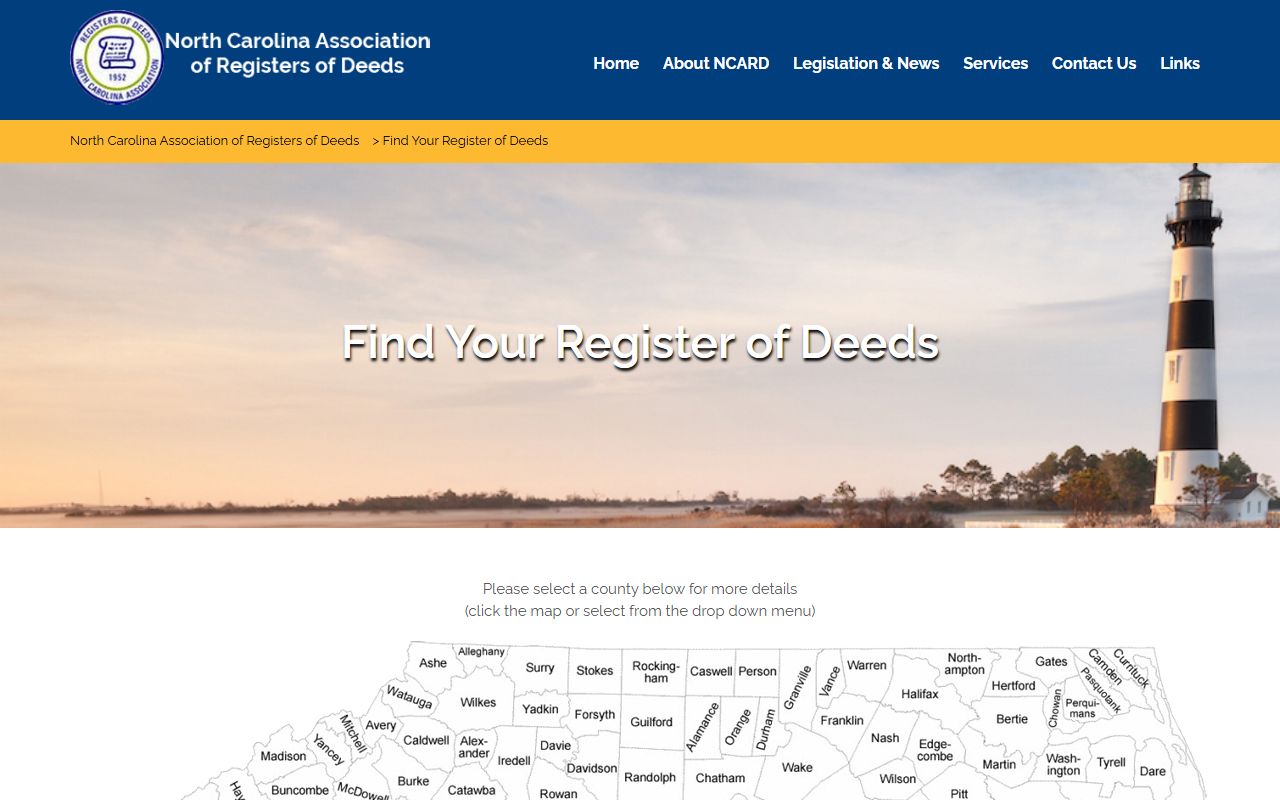
Use this directory to find the Surry County Register of Deeds contact information.
Searching Surry County Land Records
Property searches in Surry County begin with the grantor and grantee indexes. The grantor index lists sellers and transferors. The grantee index lists buyers and recipients. You can search by name to find all recorded transfers for a given person or company.
A full title search starts with the grantee index. Find the current owner's deed and then trace backward through each prior transfer. This builds the chain of title. Each link should connect smoothly to the next. Breaks or gaps may indicate problems that need attention. In a county as old as Surry, the chain can go back many generations.
North Carolina law under N.C.G.S. Chapter 161 requires each Register of Deeds to maintain accurate indexes. Surry County complies with this requirement. The indexes cover all recorded instruments from 1771 forward.
Mount Airy Property Records
Mount Airy is the largest city in Surry County. Property records for parcels in Mount Airy are recorded at the Surry County Register of Deeds in Dobson, just like any other property in the county. Town lots, commercial parcels, and residential properties in Mount Airy all appear in the county records.
Mount Airy has seen steady interest from buyers drawn to its small-town character and proximity to the Blue Ridge. The city's historic downtown includes properties with long ownership histories. Tracing title on these older parcels may require working through several decades of transfers. Some parcels date back to the original town plat.
Note: Zoning and land use questions for Mount Airy properties should be directed to the city planning office, while deed and lien records remain at the county level in Dobson.
Types of Surry County Property Records
Warranty deeds are the most common deed type in Surry County. They transfer full ownership and guarantee clear title. Quitclaim deeds also appear in the records. These transfer whatever interest the grantor holds without guarantees. Special warranty deeds offer limited protection, covering only the period of the grantor's ownership.
Deeds of trust secure real estate loans. North Carolina uses deeds of trust, not mortgages. The borrower conveys the property to a trustee as collateral. When the loan is paid, a cancellation is filed. Default can lead to a foreclosure sale by the trustee. These documents are all recorded and indexed in Surry County.
Recorded liens include:
- Tax liens from unpaid property taxes
- Mechanic's liens from contractors
- Judgment liens from court orders
- Federal tax liens
Each lien stays on record until it is satisfied or released. Plats and subdivision maps show lot lines, easements, and road layouts for divided land in Surry County.
Recording Documents in Surry County
Documents recorded in Surry County must meet the standards of N.C.G.S. Chapter 47. They must be signed, notarized, and include a return address on the first page. The grantor's name must match the prior deed. Documents that fail to meet these requirements may be rejected.
Recording fees and excise taxes are collected at the time of filing. The excise tax is one dollar per five hundred dollars of the sale price, under N.C.G.S. Chapter 105. Both must be paid before the document is filed and indexed.
Title Research and Historical Records
Title research in Surry County means tracing ownership from the current holder back through every prior transfer. A thorough search covers deeds, deeds of trust, liens, judgments, easements, and covenants. The Marketable Title Act allows most searches to stop at 30 years. Older claims not re-recorded may be extinguished.
Surry County's long history means some title chains reach back to colonial-era grants. The North Carolina State Archives holds many of these older documents. Researchers can access them in Raleigh or, in some cases, online. The North Carolina Secretary of State maintains business entity records for companies or trusts that may own property in the county.
Foothills and mountain parcels in northern Surry County may have older descriptions that reference ridgelines, creeks, or roads that have changed over time. A surveyor familiar with the area can help match these old descriptions to current boundaries.
Surry County Tax Property Records
The Surry County tax office maintains assessed values and payment records for every parcel. These records show the county's valuation and whether taxes are paid. Unpaid taxes lead to liens that attach to the property.
Revaluations in North Carolina happen at least every eight years. Surry County follows this cycle. Assessed values can change based on market trends, new construction, and improvements. Buyers should review tax records along with deed records before making a purchase. Together, these records provide a clear picture of ownership, value, and obligations for any property in Surry County.