
Stokes County Property Records Guide
Stokes County property records are maintained at the Register of Deeds office in Danbury, North Carolina. Sitting in the northern Piedmont near the Virginia border, Stokes County holds land documents going back to the late 1700s. The Register of Deeds records and indexes all real estate transactions for the county. Public access is available at the courthouse. These records include deeds, liens, plats, and other instruments that document ownership and transfers across the county's rural landscape.
Stokes County Quick Facts
Stokes County Register of Deeds
The Stokes County Register of Deeds office sits in the historic courthouse in Danbury, one of the smallest county seats in North Carolina. Despite the town's small size, the office handles a full range of recorded land documents. Staff record deeds, deeds of trust, plats, liens, easements, and other instruments. Each document is indexed by name and type for public access.
Stokes County was formed in 1789 from Surry County. It covers about 452 square miles of rolling hills, river bottoms, and Sauratown Mountains terrain. Hanging Rock State Park draws visitors from across the region. Land in Stokes County ranges from fertile farmland along the Dan River to wooded mountain slopes near the park. These varied landscapes shape the types of property records found at the courthouse.
The North Carolina Association of Register of Deeds provides a statewide directory. You can use it to find the Stokes County office address, phone number, and hours.
Searching Stokes County Land Records
Finding property records in Stokes County begins at the Register of Deeds office in Danbury. The grantor index lists those who sold or transferred land. The grantee index lists those who received it. Search by name to find transfers for a specific person or entity.
A title search starts with the current owner in the grantee index and works backward through each prior deed. This builds the chain of title. Each link should connect to the previous one. Gaps in the chain may need to be resolved before a property can be sold. For documents recorded before 1789, check Surry County records, since Stokes was formed from Surry.
Under N.C.G.S. Chapter 161, the Register of Deeds must keep accurate and complete indexes. Stokes County meets these requirements. The indexes span from the county's formation to the present.
The North Carolina General Statutes governing recording and indexing are shown in the resource below.
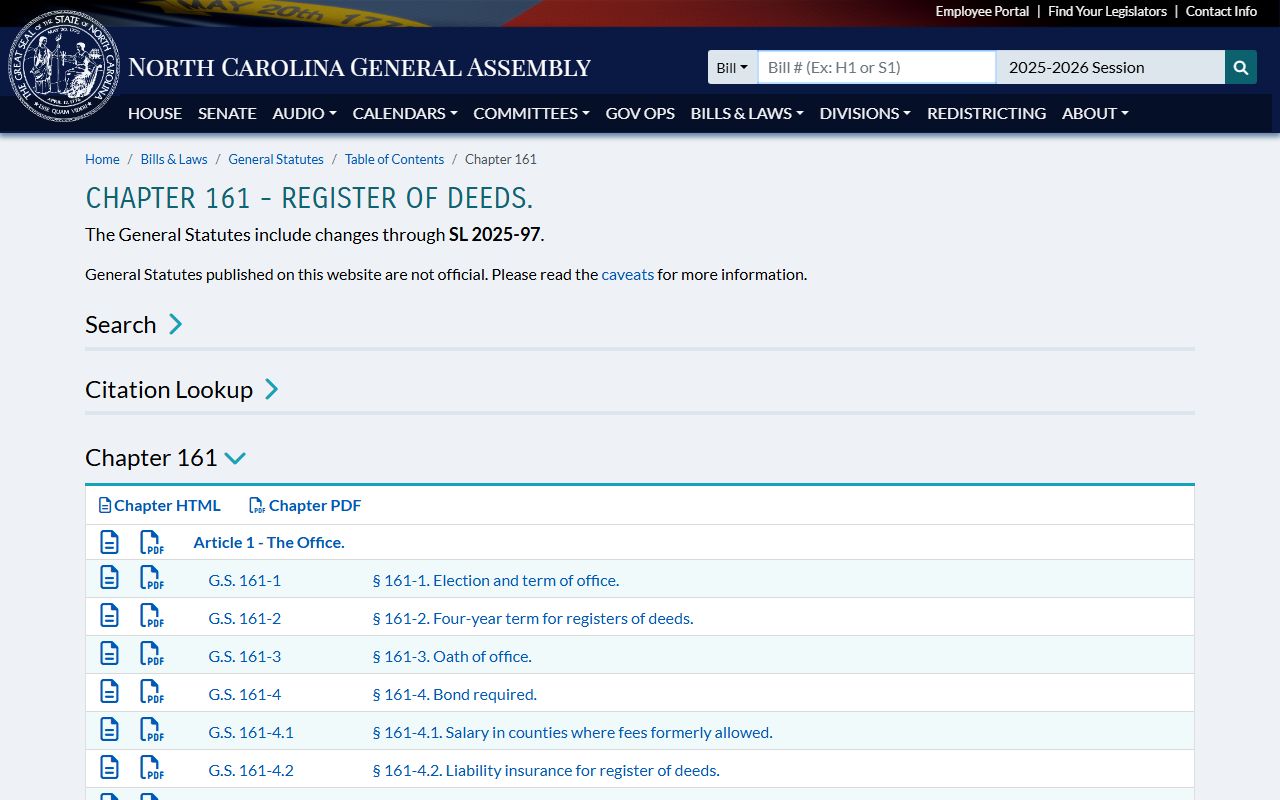
These statutes set the standards Stokes County follows for maintaining property records.
Types of Stokes County Property Records
Warranty deeds make up the bulk of recorded transfers in Stokes County. They convey ownership and guarantee clear title. Quitclaim deeds transfer whatever interest the grantor holds without promises about the title. These are common when property passes between family members or in boundary line agreements.
Deeds of trust secure real estate loans in Stokes County. North Carolina uses this system instead of mortgages. The borrower conveys the property to a trustee who holds it as security. When the loan is satisfied, a cancellation is recorded. If the borrower fails to pay, the trustee may sell the property under state foreclosure rules.
Liens are another important category. Tax liens, mechanic's liens, and judgment liens all appear in Stokes County records. They attach to the property and remain until released. Plats and maps round out the collection. These show lot boundaries, subdivision layouts, and easements that affect how land can be used.
Recording Documents in Stokes County
To record a document in Stokes County, you must meet the requirements of N.C.G.S. Chapter 47. Documents must be signed and properly notarized. A return address is required on the first page. The grantor's name must match the name in the prior recorded deed for the property.
Recording fees and the excise tax are due at the time of filing. The excise tax on real estate transfers is one dollar per five hundred dollars of sale price, as set by N.C.G.S. Chapter 105. The Register of Deeds collects these amounts before the document is entered into the Stokes County records system.
Stokes County Title Research
Title research in Stokes County traces ownership from the current holder back through every recorded transfer. The search covers deeds, deeds of trust, liens, judgments, easements, and restrictive covenants. A complete search reveals whether the title is clear or if there are issues that need to be resolved.
The Marketable Title Act limits how far back most searches need to go. Under this law, a chain of title covering 30 years is usually sufficient. Older claims that were not re-recorded may be extinguished. This protects buyers and lenders in Stokes County.
Rural land in Stokes County can present special title issues. Older parcels may use vague descriptions based on natural features. Family-held land may lack formal recorded transfers for some generations. A title professional familiar with the area can help sort through these situations and identify what steps are needed to clear the title.
Historical Property Records
Stokes County's history stretches back to the colonial era. Early settlers farmed the Dan River valley and the surrounding hills. Land grants from the state helped open the area to settlement in the late 1700s. Tobacco farming became a major part of the local economy, and many land records from that era reflect the agricultural character of the county.
The North Carolina State Archives holds older grants and documents tied to Stokes County land. Researchers can access these materials in Raleigh. Some records have been digitized and are available online. The North Carolina Secretary of State maintains business entity records that may be relevant when property is held by a company or trust in Stokes County.
The State Archives is a valuable resource for historical land research in Stokes County.
Stokes County Property Tax Records
The Stokes County tax office maintains assessed values and payment histories for all parcels in the county. Tax records show the assessed value, the tax rate, and whether taxes are current. Unpaid taxes can result in a lien that attaches to the property and must be resolved before the land can be sold.
North Carolina requires property revaluations at least every eight years. Stokes County follows this schedule. During a revaluation, every parcel is reassessed based on current market conditions. Buyers should check both the deed records and the tax records before purchasing property in Stokes County. This provides a full picture of ownership, value, and any financial obligations tied to the land.