
Stanly County Real Property Records
Stanly County property records are kept by the Register of Deeds in Albemarle, North Carolina. Located in the south-central Piedmont, Stanly County holds land documents that date back to the early 1840s. The Register of Deeds office records and indexes all real estate transactions within the county. Residents and the public can search these records at the courthouse in Albemarle. From deeds and liens to plats and easements, Stanly County property records provide the foundation for understanding land ownership in this part of the state.
Stanly County Quick Facts
Stanly County Register of Deeds
The Stanly County Register of Deeds office operates out of the courthouse in Albemarle. This is the central office for all recorded land documents in the county. Staff record deeds, deeds of trust, plats, liens, and other instruments tied to real estate. They index each document so the public can search by name, date, or document type.
Stanly County was formed in 1841 from Montgomery County. It sits along the Yadkin and Pee Dee rivers in the Piedmont region. The county covers about 395 square miles. Albemarle, the county seat, anchors the area as its largest city. Land transactions in Stanly County range from residential lots in Albemarle and Locust to rural farm tracts and lakefront parcels near Lake Tillery and Badin Lake.
The North Carolina Association of Register of Deeds maintains a directory of all county offices across the state. You can find the Stanly County office address, phone number, and hours through this resource.
Searching Stanly County Property Records
Property searches in Stanly County start with the grantor and grantee indexes at the Register of Deeds. The grantor index lists sellers. The grantee index lists buyers. Search by name to find all transfers for a specific person or business.
For a title search, begin with the current owner in the grantee index and work backward. Each transfer should link to the one before it. This builds the chain of title. A clean, unbroken chain confirms that ownership has passed properly from one party to the next over time. If a gap appears, it may need to be addressed before the property can change hands again.
Under N.C.G.S. Chapter 161, the Register of Deeds must maintain complete indexes. Stanly County follows this mandate. The indexes go back to 1841, when the county was formed. For older records, check Montgomery County, the parent county.
The image below shows the North Carolina General Statutes that set standards for recording and indexing property documents.
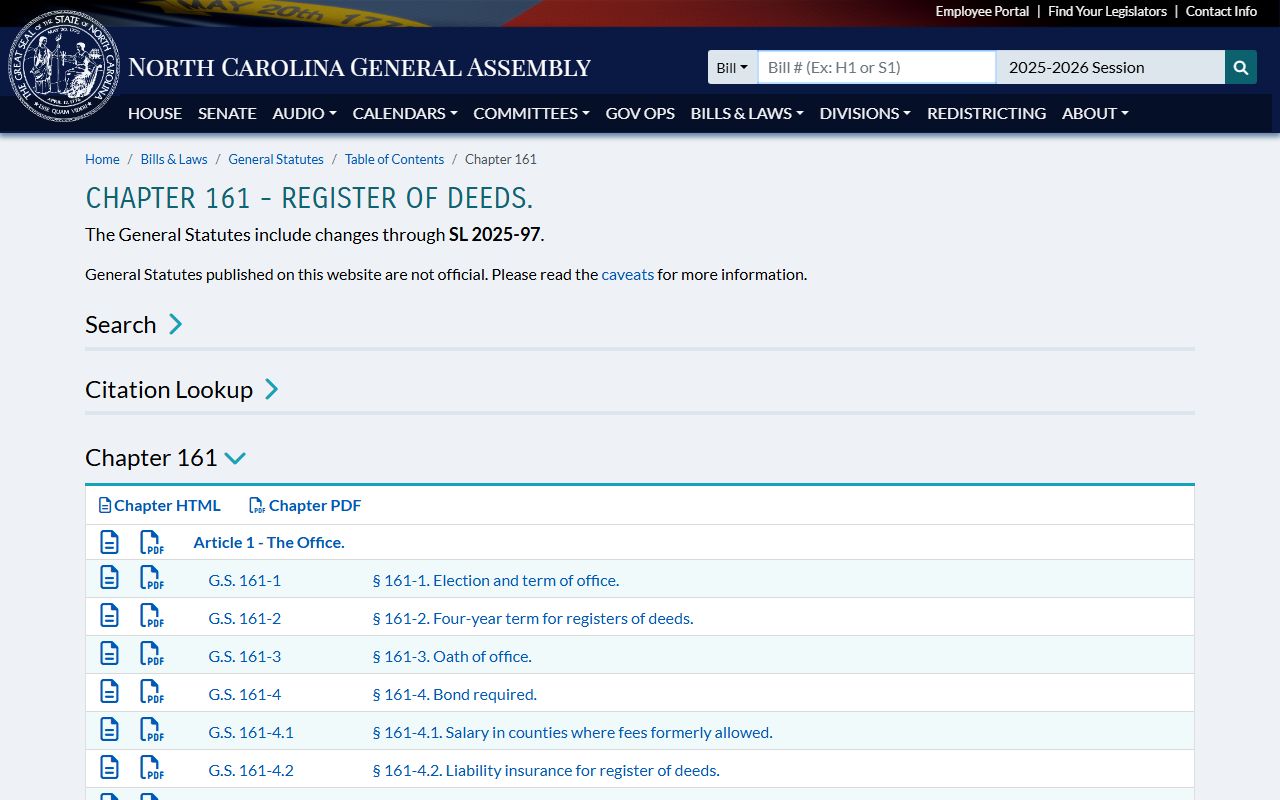
These statutes govern how Stanly County maintains its property records.
Lake Property Records in Stanly County
Stanly County borders two major lakes. Lake Tillery and Badin Lake both attract buyers looking for waterfront property. These parcels often have unique title considerations. Dam construction in the early 1900s created the lakes, and land boundaries changed as a result. Some older deeds reference landmarks or contours that no longer exist in their original form.
Waterfront lots may also carry easements for utility access, boat ramps, or flood zones. These easements are recorded at the Register of Deeds and show up during a title search. Buyers should pay close attention to what rights and restrictions come with lakefront land in Stanly County. A careful review of the plat and any recorded covenants will clarify what the property includes and what limits apply.
Types of Stanly County Property Records
Warranty deeds are the standard in Stanly County. They transfer ownership and guarantee that the title is free of defects. Quitclaim deeds are also common, especially in family transfers. These convey whatever interest the grantor holds but make no promises about the condition of the title.
Deeds of trust are filed when buyers finance real estate purchases. North Carolina uses this system rather than traditional mortgages. The borrower transfers the property to a trustee as security for the loan. Once the debt is paid, a cancellation is recorded. If the borrower defaults, the trustee may sell the property following state foreclosure procedures.
Other recorded instruments include tax liens, mechanic's liens, judgment liens, and easements. All of these attach to the property and remain on record until released. Plats and subdivision maps show the physical layout of parcels, including lot lines, roads, and dedicated areas.
Recording Property Documents
Recording requirements in Stanly County follow N.C.G.S. Chapter 47. Documents must be signed, notarized, and include a return address. The grantor's name must match the prior deed. Documents that do not meet these standards will be rejected.
Fees are collected at the time of recording. The excise tax on real estate sales is one dollar per five hundred dollars of the sale price, as required by N.C.G.S. Chapter 105. Both the recording fee and the excise tax must be paid before the document is filed in Stanly County.
Stanly County Title Research
A title search in Stanly County builds a chain of ownership from the current holder back through every prior transfer. The search includes deeds, deeds of trust, liens, judgments, easements, and covenants. A complete chain shows that ownership has been properly transferred at each step.
The Marketable Title Act in North Carolina limits how far back a search typically needs to go. A chain of 30 years is usually enough. Older claims not re-recorded may be extinguished. This law protects buyers and lenders who rely on the recorded chain in Stanly County.
For historical research, the North Carolina State Archives holds early land grants and records. The North Carolina Secretary of State maintains business entity filings that may relate to property held by companies or trusts in Stanly County.
Stanly County Tax Records
The Stanly County tax office maintains assessed values and payment records for every parcel. Tax records show the appraised value, the tax rate, and the payment status. This information helps buyers understand the financial obligations tied to a property.
North Carolina requires revaluations at least every eight years. Stanly County follows this schedule. During a revaluation, every parcel in the county is reassessed. Values may go up or down based on market conditions and improvements. Checking the tax records alongside the deed records gives a thorough picture of any property in Stanly County before a purchase.