
Sampson County Land Property Records
Sampson County property records are housed at the Register of Deeds office in Clinton, North Carolina. As the largest county by land area in the state, Sampson County holds a vast collection of recorded land documents. The office records deeds, liens, plats, and other instruments tied to real estate. Public access is available in person at the courthouse. These records serve buyers, sellers, title researchers, and anyone who needs to verify ownership or check for liens on property in Sampson County.
Sampson County Quick Facts
Sampson County Register of Deeds
The Sampson County Register of Deeds is located in the courthouse in Clinton. This office handles all recorded land documents in the county. Staff record deeds, deeds of trust, plats, liens, and related instruments. Each document is indexed by name, date, and type so it can be found later. The office also handles vital records for the county.
Sampson County was formed in 1784 from Duplin County. It spans over 940 square miles, making it the largest county in North Carolina by area. Most of the land is flat coastal plain used for farming. Agriculture has shaped the county's land records for centuries. Large tracts of farmland, timber land, and rural homesteads make up the bulk of recorded transactions. The county seat, Clinton, sits near the center of this broad landscape.
You can find contact details for the Sampson County Register of Deeds through the North Carolina Association of Register of Deeds directory. This resource lists phone numbers, addresses, and office hours for every county in the state.
Searching Sampson County Property Records
Finding property records in Sampson County starts with the grantor and grantee indexes. The grantor index lists those who sold or transferred land. The grantee index lists those who received it. You can search by name to find all recorded transfers for a given person or entity.
If you have a book and page number, staff can pull the document right away. For a full title search, start with the grantee index and trace ownership backward. Each transfer should connect to the next, forming an unbroken chain. Breaks in the chain may need to be resolved before a sale can proceed.
Under N.C.G.S. Chapter 161, the Register of Deeds must maintain accurate indexes for all recorded documents. Sampson County follows these requirements. The indexes cover instruments from the county's formation in 1784 to the present.
Given the county's large size, parcels can be spread across many townships. Knowing the township or general location helps narrow your search when dealing with common names.
Deed Types in Sampson County
Several types of documents make up Sampson County property records. Warranty deeds transfer full ownership with a guarantee of clear title. They are the most common deed type. Quitclaim deeds transfer whatever interest the grantor holds without any promises about the title. These often show up in family transfers or boundary corrections.
Deeds of trust secure real estate loans. North Carolina uses deeds of trust instead of mortgages. The borrower conveys the property to a trustee who holds it as collateral for the lender. When the loan is paid, a cancellation is recorded in Sampson County. If the borrower defaults, the trustee can sell the property through a foreclosure process governed by state law.
Liens are also recorded in Sampson County. Tax liens arise when property taxes go unpaid. Mechanic's liens protect contractors and suppliers. Judgment liens come from court orders. All liens attach to the property and stay on record until they are satisfied or released. Plats and subdivision maps round out the record. These show lot boundaries, easements, and road access for parcels across the county.
Recording Property Documents
To record a document in Sampson County, it must meet the requirements of N.C.G.S. Chapter 47. All documents must be signed and notarized. The first page must show a return address. The grantor's name must match the name in the prior recorded deed. Failure to meet these standards will result in rejection.
Recording fees are collected when the document is filed. The excise tax on real estate transfers is also due at that time. North Carolina sets the excise tax at one dollar per five hundred dollars of the sale price, as outlined in N.C.G.S. Chapter 105. The Register of Deeds collects both fees before the document enters the county records.
The North Carolina General Statutes that govern the recording process are shown in the resource below.
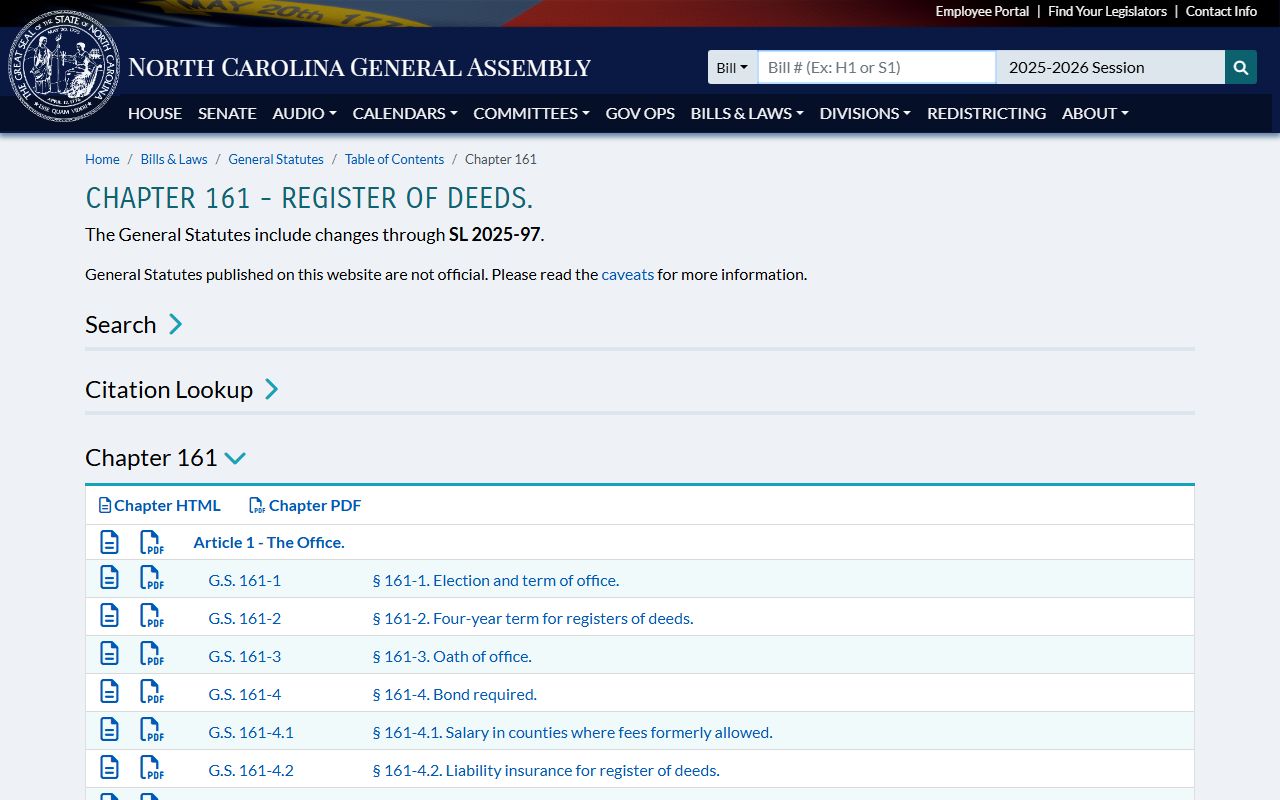
These statutes apply to all documents recorded in Sampson County.
Sampson County Title Research
Title research in Sampson County involves building a complete chain of ownership for a given parcel. Starting with the current owner, a searcher traces back through each prior deed. The search also covers deeds of trust, liens, judgments, easements, and covenants. Every link must be verified.
The Marketable Title Act helps simplify searches in North Carolina. A chain of title going back 30 years is generally enough. Older claims that were not re-recorded may be cut off under this law. This gives buyers and lenders in Sampson County confidence that the recorded chain reflects true ownership.
Farmland in Sampson County presents its own title considerations. Large tracts may have been subdivided over the decades, with portions sold to different buyers. Family farms passed down through generations sometimes lack formal recorded deeds. In these cases, a title professional can help identify missing links and recommend steps to clear the title.
Historical Land Records
Sampson County's history as an agricultural center shapes its property records. Early settlers received land grants from the state. Many of these grants covered hundreds of acres of coastal plain. Over time, the land was divided, sold, and passed down. The records at the Register of Deeds trace these changes from the 1780s to today.
The North Carolina State Archives holds older land grants and historical records that may relate to Sampson County parcels. Researchers interested in early land ownership will find these archives helpful. The North Carolina Secretary of State maintains records for business entities that may hold property in the county.
The State Archives is a key resource for historical research on Sampson County land records.
Sampson County Property Tax Records
The Sampson County tax office keeps assessed values and payment records for all parcels. Tax records show what the county believes a property is worth. They also show whether taxes are current or past due. Unpaid taxes can result in a lien that attaches to the property.
North Carolina counties revalue property at least every eight years. Sampson County follows this schedule. Buyers should review both deed records and tax records before purchasing property. This gives a complete view of ownership, value, and any obligations tied to the land.