
Rutherford County Property Records
Rutherford County property records are maintained by the Register of Deeds in Rutherfordton, North Carolina. This foothills county sits along the eastern edge of the Blue Ridge Mountains and holds a rich collection of land documents dating back to the late 1700s. The Register of Deeds office records and indexes all real estate transactions in the county. Residents and the public can access deeds, liens, plats, and other recorded instruments through this office. Whether you are buying land, selling a home, or tracing ownership history, Rutherford County property records provide the details you need.
Rutherford County Quick Facts
Rutherford County Register of Deeds
The Rutherford County Register of Deeds office sits in the courthouse in Rutherfordton. This office is the official custodian of all land records in the county. Staff record deeds, deeds of trust, plats, liens, and other instruments tied to real property. They also build and maintain indexes so the public can search for documents by name, date, or type.
Rutherford County was formed in 1779 from parts of Tryon County. Property records here stretch back to that era. Early land grants from the state of North Carolina helped settle the foothills region. Today the county covers roughly 564 square miles of rolling hills, river valleys, and mountain slopes. Land transactions reflect that variety, from farmland along the Broad River to wooded mountain tracts near the Blue Ridge.
The North Carolina Association of Register of Deeds maintains a statewide directory. You can use it to find contact details, hours, and the address for the Rutherford County office. Phone and mail requests are also accepted for basic record lookups.
The resource below shows the statewide directory for locating Register of Deeds offices across North Carolina.
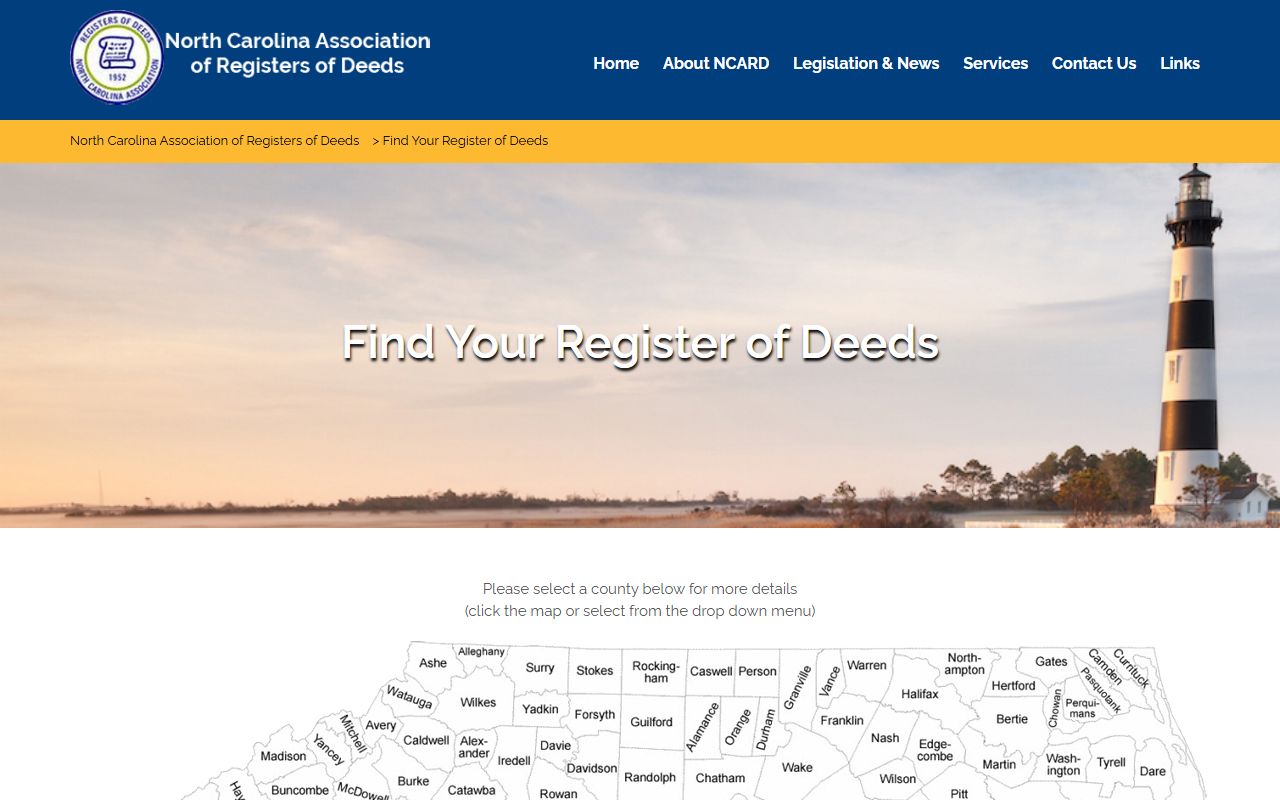
Use this directory to find the Rutherford County Register of Deeds contact information.
Searching Rutherford County Land Records
To search Rutherford County property records, start with the grantor and grantee indexes at the Register of Deeds office. The grantor index lists sellers. The grantee index lists buyers. You can search by name to find all recorded transfers for a specific person or business. If you have a book and page number, staff can pull the document directly.
For a full title search, begin with the grantee index and trace ownership backward through each prior transfer. This process builds a chain of title for the parcel in question. Each link in the chain should connect to the next. Gaps or breaks may signal problems that need attention before a sale can close.
North Carolina law under N.C.G.S. Chapter 161 requires each county Register of Deeds to maintain complete and accurate indexes. Rutherford County follows these rules. The indexes cover all recorded instruments from the county's formation to the present day.
Types of Rutherford County Property Records
Warranty deeds are the most common type of deed recorded in Rutherford County. They transfer full ownership and guarantee that the title is clear. Quitclaim deeds also appear in the records. These transfer whatever interest the grantor holds but offer no guarantees about the state of the title. Special warranty deeds provide limited protection, covering only the time the grantor owned the property.
Deeds of trust are filed when a buyer takes out a loan to purchase real estate. North Carolina is a deed of trust state, not a mortgage state. The borrower conveys the property to a trustee who holds it as security for the lender. When the loan is paid off, a cancellation is recorded. If the borrower defaults, the trustee may sell the property under the rules set out in state law.
Other documents found in Rutherford County records include:
- Tax liens from unpaid property taxes
- Mechanic's liens filed by contractors
- Judgment liens resulting from court orders
- Plats and subdivision maps showing lot lines and easements
- Right-of-way and utility easements
All of these attach to the property and remain on record until resolved or released.
Recording Documents in Rutherford County
Recording a deed or other instrument in Rutherford County requires meeting the standards set by N.C.G.S. Chapter 47. Documents must be signed and notarized. The first page must include a return address. The grantor's name must match the name shown in the prior deed for the property. If these requirements are not met, the Register of Deeds may reject the document.
Recording fees apply. The excise tax on real estate transfers is collected at the time of recording as well. North Carolina sets this tax at one dollar per five hundred dollars of the sale price, under N.C.G.S. Chapter 105. The Register of Deeds collects both the recording fee and the excise tax before filing and indexing the document.
The image below shows key North Carolina statutes that govern the recording process.
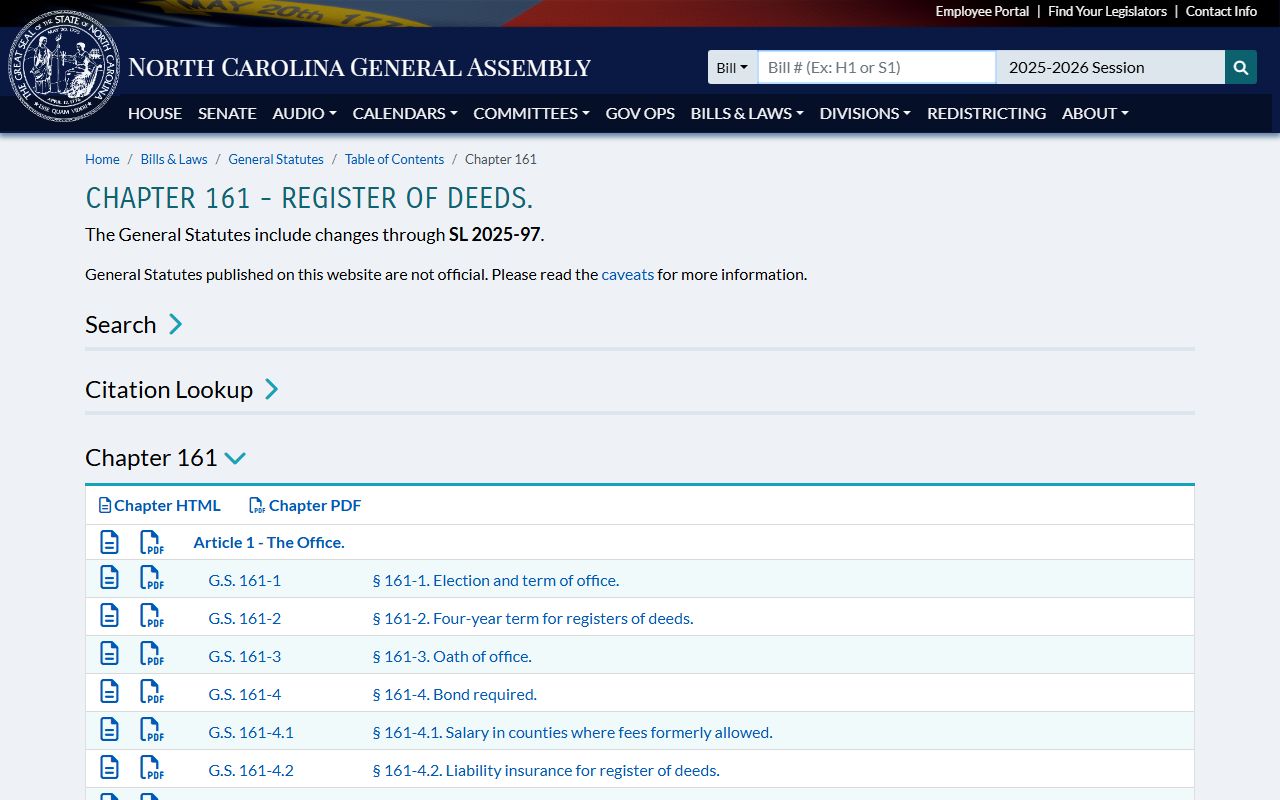
These statutes set the rules Rutherford County follows for recording all property documents.
Title Research in Rutherford County
Title research in Rutherford County means tracing a property's ownership from the current holder back through every prior transfer. A thorough search covers deeds, deeds of trust, liens, judgments, easements, and restrictive covenants. Every link in the chain must be accounted for.
The Marketable Title Act in North Carolina helps simplify this process. Under the act, a chain of title going back 30 years is generally sufficient. Older claims not renewed or re-recorded may be cut off. This protects buyers and lenders in Rutherford County who rely on the recorded chain.
Foothills land in Rutherford County can present unique issues. Older parcels may have legal descriptions that reference creeks, ridges, or old road beds that have changed over time. Family land passed down through generations sometimes lacks clear recorded transfers. A title professional familiar with the county can help resolve these gaps and confirm that ownership is clear.
Historical Property Records
Rutherford County has a deep history. Named for General Griffith Rutherford, the county played a role in the settlement of western North Carolina. Early land grants helped open the foothills to farming and industry. The Broad River and its tributaries shaped how land was divided and used. Gold mining brought settlers to the area in the early 1800s, and many land transfers from that period remain in the county records.
The North Carolina State Archives holds older land grants and historical documents that may relate to Rutherford County parcels. Researchers studying early land ownership in the foothills will find these archives valuable. Some records have been digitized, while others require a visit to the archives in Raleigh.
The North Carolina Secretary of State maintains business entity records. If a Rutherford County property is held by a company or trust, this office can help identify the entity and its registered agent.
Rutherford County Tax Records
The Rutherford County tax office maintains assessed values and tax payment records for every parcel in the county. These records show what a property is worth for tax purposes. They also reveal whether taxes are current or past due. Tax data complements the deed records at the Register of Deeds.
North Carolina counties must revalue all property at least every eight years. Rutherford County follows this schedule. A revaluation can change assessed values across the county, sometimes significantly. Buyers should check both the deed records and the tax records before closing on any property in Rutherford County. This gives a full picture of ownership, value, and any outstanding obligations tied to the land.