
Polk County NC Property Records
Polk County property records are managed by the Register of Deeds office in Columbus, North Carolina. Located in the western foothills near the South Carolina border, Polk County is one of the smallest counties in the state. The register's office records deeds, deeds of trust, plat maps, liens, and other instruments affecting real property. Despite its small size, Polk County attracts buyers drawn to its mountain views, mild climate, and proximity to Tryon and the thermal belt. Records at the office date back to the county's formation in 1855.
Polk County Quick Facts
Polk County Register of Deeds
The Polk County Register of Deeds office is in the courthouse in Columbus. Staff record and index all land documents filed in the county. Deeds, deeds of trust, plat maps, and liens are the most common filings. The office also processes vital records.
Columbus is a quiet town. The register's office sees lower filing volumes than larger counties, which often means shorter wait times and more personal service. Staff can help locate records by owner name, parcel number, or book and page reference. Certified copies of any recorded document are available for a fee. Call the office before visiting to confirm hours and ask about the document you need.
The North Carolina Association of Register of Deeds lists contact details for every county register office, including Polk County.
Foothills Property Records
Polk County sits in the foothills of the Blue Ridge Mountains. This setting creates special considerations for property records. Many parcels are on slopes or ridgelines. Deeds often reference elevation, watershed boundaries, and mountain features in their legal descriptions. Older deeds may describe property lines using ridge crests, streams, and rock outcroppings rather than modern survey coordinates.
The thermal belt around Tryon is one of the most sought-after areas in Polk County. This microclimate, known for mild winters, has attracted buyers since the late 1800s. Property records in the Tryon area include estates, horse farms, and mountain retreats. Many of these parcels have long and detailed chains of title. Restrictive covenants are common in the older neighborhoods and equestrian communities.
Mountain terrain can also affect access rights. Easements for roads, driveways, and utilities are important in Polk County. If a parcel is landlocked, the deed should reference an access easement. Checking for these in the property records is a key step before any purchase in the foothills.
Polk County Deed Types
Several deed types appear in Polk County records. General warranty deeds provide the broadest protection. They guarantee clear title through the entire ownership history. Special warranty deeds cover only the period the seller owned the land. Quitclaim deeds transfer whatever interest the grantor has with no warranties at all.
Deeds of trust are filed whenever a buyer borrows money to purchase property in Polk County. North Carolina uses deeds of trust instead of mortgages. Three parties are named: the borrower, the lender, and a trustee who holds legal title until the loan is satisfied. After the borrower pays the debt, the lender records a cancellation. This releases the lien from the property's record in Polk County.
Recording in Polk County
All property documents filed in Polk County must comply with state recording standards. N.C.G.S. Chapter 47 governs the requirements. Each instrument must be signed and notarized. A return address must appear on the first page. The grantor's name must match what shows on the prior deed in the chain.
Polk County collects excise tax on real estate sales at the rate of one dollar per five hundred dollars of the sale price, as set by N.C.G.S. Chapter 105. Recording fees cover indexing and storage. Both the tax and fee are collected at the time of filing. Documents should be originals unless a statute allows copies.
Electronic recording under N.C.G.S. Chapter 47B is available for qualified submitters. This lets title companies and attorneys file documents remotely, which is convenient for those who are not near Columbus.
State recording rules apply the same way in every North Carolina county.
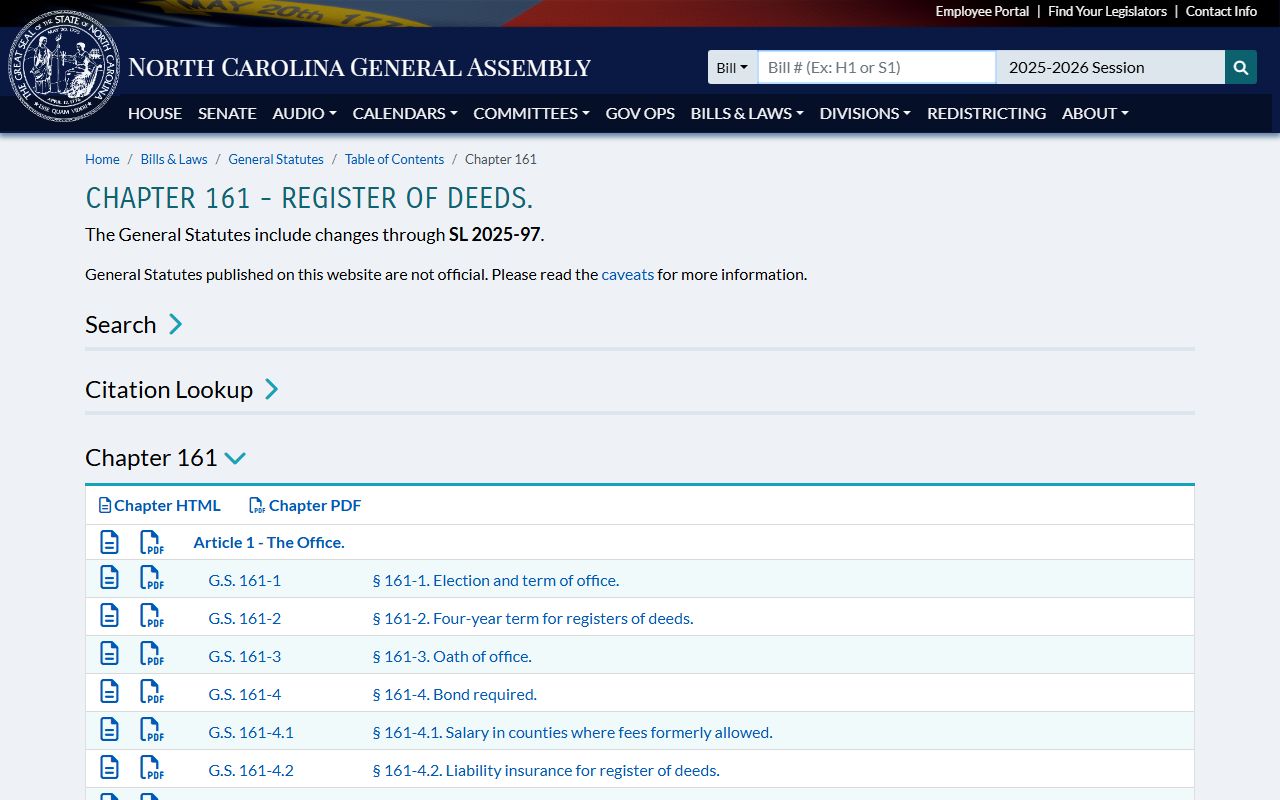
These statutes set the baseline for recording in all 100 North Carolina counties, including Polk.
Polk County Title Research
Title research in Polk County traces ownership through the grantor and grantee indexes at the register's office. A searcher starts with the current owner and works backward. Each deed references the one before it, forming a chain of title. The goal is to make sure every link is solid and no gaps exist.
Most searches in Polk County go back at least 30 years under the state's Marketable Title Act. This law generally treats a 30-year chain as sufficient. Older claims not re-recorded within that period may be cut off. A full search also reviews liens, judgments, easements, and covenants. In Polk County, checking for access easements and restrictive covenants is especially important given the mountain terrain and established neighborhoods.
Historical Polk County Records
Polk County was created in 1855 from parts of Henderson and Rutherford Counties. Records before that date are held by those parent counties. The register's office in Columbus has the complete record from 1855 forward. Early documents include handwritten deeds and grants on large paper pages bound into volumes.
The North Carolina State Archives holds additional materials, including early land grants and court records. These are useful when tracing Polk County property back before the county existed. Estate records at the archives sometimes reference land transfers not found in county files. The North Carolina Secretary of State maintains business and UCC filing records that may also be relevant to property research.
Polk County's history as a resort and equestrian area is reflected in its records. Old deeds mention horse farms, inns, and resort properties. These give a sense of how the area developed from rural farmland into the community it is today. Researchers and historians find these early documents full of local detail.