
Graham County Property Records
Graham County property records are maintained at the Register of Deeds office in Robbinsville, North Carolina. This small mountain county was formed in 1872 from Cherokee County. It sits in the far western corner of the state, surrounded by the Nantahala National Forest and the Great Smoky Mountains. Land records here include deeds, plats, liens, and deeds of trust. The county's rugged landscape and limited development give its property records a unique character. Owners, buyers, and researchers can access these records to verify title, check boundaries, and trace land history.
Graham County Quick Facts
Graham County Register of Deeds
The Register of Deeds office in Graham County sits in Robbinsville. Staff record deeds, deeds of trust, plat maps, liens, and other instruments tied to real property. The office also handles vital records. Graham County is one of the least populated counties in North Carolina, so the volume of recordings is lower than in urban areas.
Graham County was carved from Cherokee County in 1872. The county covers about 302 square miles, much of it mountainous terrain. A large portion of the land is federal forest. The Nantahala National Forest and parts of the Great Smoky Mountains National Park take up much of the county. Private parcels tend to be in the valleys and along the rivers. This means the pool of taxable and transferable land is smaller than in most counties.
The NC Association of Register of Deeds lists contact information for the Graham County office and all other county offices in the state. Use this directory to get the current address, phone number, and hours before you visit.
Graham County Tax Office
The Graham County Tax Office handles property assessments and tax collections. This office maintains records of assessed values, tax rates, and payment histories for all parcels in the county. You can contact them for questions about valuations, tax bills, and payment schedules.
North Carolina requires counties to reappraise property on a regular cycle under N.C.G.S. Chapter 105. Graham County follows this requirement. During reappraisal, staff look at sales data and property conditions to set new values. Property owners can appeal their assessed value if they believe it is not accurate.
Below is a view of the Graham County Tax Office page.
The tax office page provides information on assessments and tax administration in Graham County.
Note: Much of the land in Graham County is owned by the federal government. Only private parcels are subject to county property taxes.
Searching Graham County Property Records
To search Graham County property records, visit the Register of Deeds office in Robbinsville. Bring whatever details you have about the property. An owner name, parcel number, or address will help. Staff maintain grantor and grantee indexes that list all recorded transfers.
Mountain land in Graham County can present unique challenges. Steep slopes, creeks, and ridgelines form natural boundaries that older deeds often reference. Metes and bounds descriptions may mention trees, rocks, or waterways that have shifted over time. Surveys are especially important in this kind of terrain. If you are buying mountain land in Graham County, a fresh survey can help confirm that the legal description matches the actual ground.
Graham County's remote location means that most record searches must be done in person. Travel to Robbinsville takes time from any major city. Plan your visit in advance and call ahead to confirm the office is open.
Deed Types in Graham County Records
Graham County property records include several deed types. General warranty deeds give buyers the strongest protection. The seller guarantees clear title through the entire history of the property. Special warranty deeds limit that guarantee to the seller's time of ownership. Quitclaim deeds pass along whatever interest the grantor holds with no promises.
Deeds of trust are the standard instrument for securing a home loan in North Carolina. Under N.C.G.S. Chapter 45, a deed of trust names a trustee who holds the power to sell the property if the borrower defaults. When the loan is paid off, a cancellation is recorded in Graham County property records.
Liens also appear in the records. Tax liens attach to property when taxes go unpaid. Mechanic's liens can be filed by contractors. Judgment liens arise from court orders. All stay on record until resolved.
Recording Documents in Graham County
Documents filed in Graham County must meet the rules in N.C.G.S. Chapter 47. They must be signed, notarized, and include a return address. The grantor's name must match the last recorded deed for the parcel.
Graham County charges the state excise tax on real estate transfers. The rate is one dollar per five hundred dollars of the sale price under N.C.G.S. Chapter 105. Recording fees apply as well and follow the schedule set by N.C.G.S. Chapter 161.
The North Carolina General Statutes that govern recording are shown below.
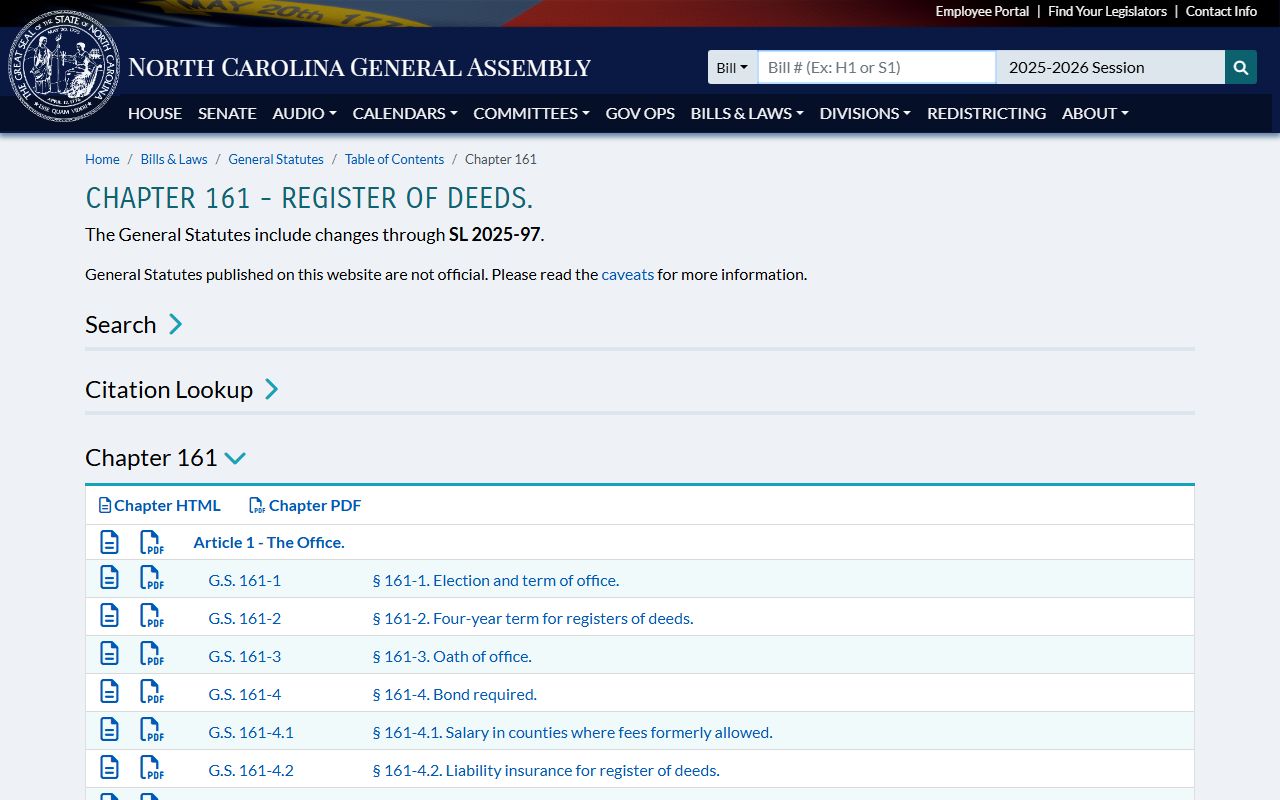
These rules apply to all documents filed in Graham County and across the state.
Title Research in Graham County
A title search in Graham County traces ownership from the current owner back through each prior transfer. The search checks for liens, easements, and other encumbrances. A clean chain of title is needed for any real estate closing.
The Marketable Title Act allows a 30-year chain of title to establish ownership. Older claims that have not been re-recorded may be extinguished. This protects buyers and lenders who rely on the recorded chain. Graham County's relatively short history, starting in 1872, means the full chain may cover the county's entire existence for some parcels.
For records that predate Graham County's formation, the North Carolina State Archives in Raleigh hold early Cherokee County records and original land grants. The Secretary of State also maintains filings that may affect property ownership.
The State Archives portal is shown below.
These archives hold early land records that may relate to property in Graham County.