
Davie County Property Records
Davie County property records are maintained by the Register of Deeds in Mocksville, North Carolina. The office records and indexes deeds, deeds of trust, liens, plats, and other land instruments for the county. Davie County sits in the Piedmont region west of Winston-Salem. Public access to these property records is available at the courthouse. Buyers, sellers, and researchers use Davie County records to verify ownership, check for encumbrances, and trace the history of real estate parcels in this growing Piedmont community.
Davie County Quick Facts
Davie County Register of Deeds
The Davie County Register of Deeds office is located in the courthouse in Mocksville. This is the official office for recording and storing all land documents in the county. Staff process deeds, deeds of trust, plats, liens, and other instruments each business day. Every document is indexed by party name, recording date, and book and page number so that the public can search for it later.
Davie County was formed in 1836 from Rowan County. Property records date back to that year. The county is named after William Richardson Davie, a Revolutionary War leader and governor of North Carolina. Mocksville serves as the county seat and is the center of government operations. The county has a rural character with farms, vineyards, and growing residential areas near Winston-Salem.
The North Carolina Association of Register of Deeds provides a statewide directory that includes Davie County. You can use this to confirm the office address, phone number, and hours before making a trip.
The statewide directory for locating Register of Deeds offices is shown below.
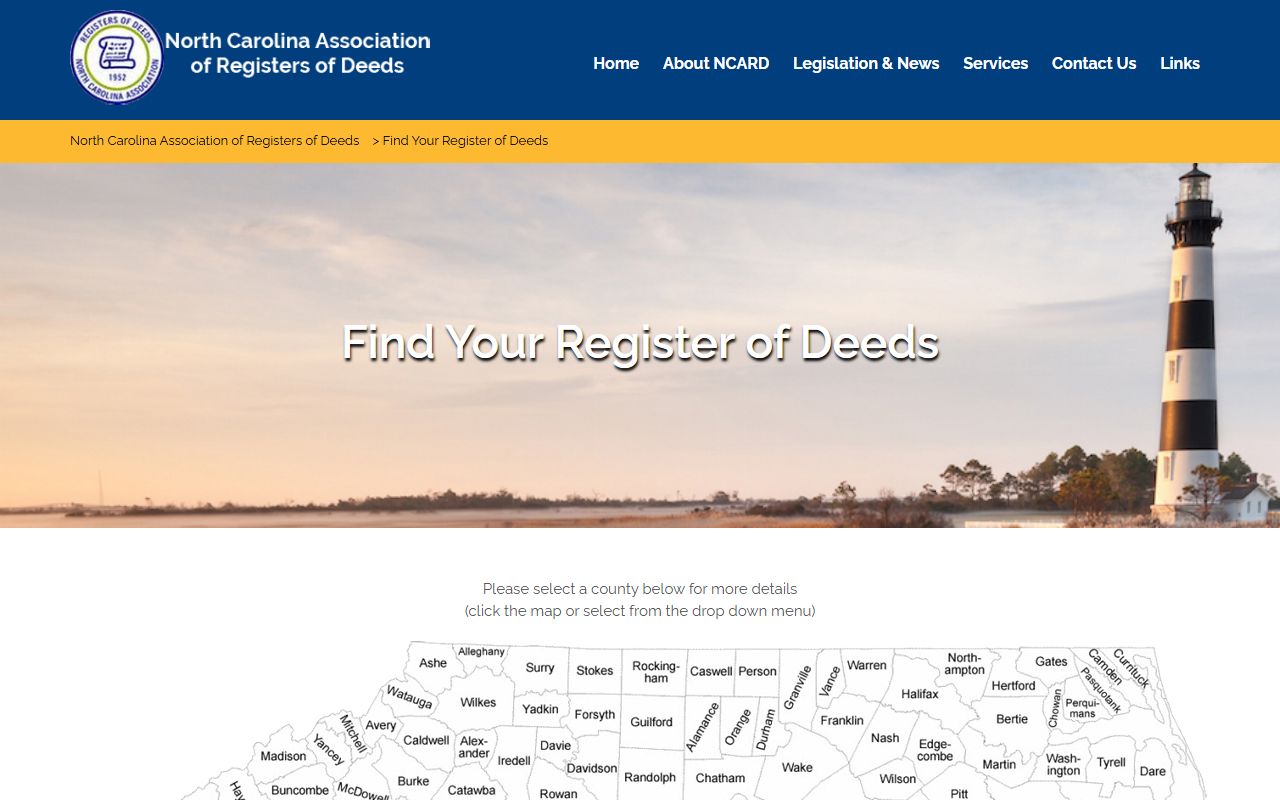
This directory helps you find the Davie County Register of Deeds and all other county offices in the state.
Searching Davie County Property Records
Searching for property records in Davie County is best done at the Register of Deeds office in Mocksville. The office keeps grantor and grantee indexes that list every recorded document. The grantor index covers those who transferred property. The grantee index covers those who received it. By searching both, you can trace ownership from the present back through each prior transfer.
If you have a book and page number, the staff can pull the document directly. For name searches, start with the grantee index to find the most recent deed. Then use the grantor index to trace backward. This builds the chain of title for the parcel. Staff can help if you are not familiar with the indexing system.
North Carolina law under N.C.G.S. Chapter 161 requires every county to maintain accurate indexes. Davie County follows this rule and updates its indexes as new documents come in.
Note: Davie County may have limited online access to property records, so plan to visit the office or call ahead for record requests.
Types of Davie County Land Records
Davie County property records contain several types of instruments. Warranty deeds are the standard for real estate sales. They transfer full ownership and guarantee clear title. Quitclaim deeds transfer only the grantor's interest without any warranty. They are common in family transfers and in clearing up title issues.
Deeds of trust are recorded whenever a lender provides financing for a real estate purchase in Davie County. North Carolina uses deeds of trust instead of mortgages. Under N.C.G.S. Chapter 45, the borrower transfers the property to a trustee who holds it as security. When the loan is fully repaid, the lender files a cancellation with the Register of Deeds. If the borrower defaults, the trustee can sell the property under the power of sale provision without going through a lengthy court process.
Liens also appear in Davie County records. Tax liens stem from unpaid property taxes. Mechanic's liens protect contractors and suppliers. Judgment liens come from court orders. Plats and subdivision maps are recorded to show lot boundaries and are referenced in future deeds for legal descriptions.
Recording in Davie County
Documents submitted for recording in Davie County must comply with N.C.G.S. Chapter 47. The document must be signed and notarized. The grantor's name must match the prior deed. A return address must be on the first page. If these standards are not met, the document will be returned.
Recording fees are charged for each document filed. These fees cover processing and indexing costs. The North Carolina excise tax on property transfers is also due at the time of recording. Under N.C.G.S. Chapter 105, this tax is one dollar per five hundred dollars of the sale price. The Register of Deeds collects the fee and the tax before the document is filed in the Davie County records.
The relevant North Carolina statutes for recording are shown in the image below.
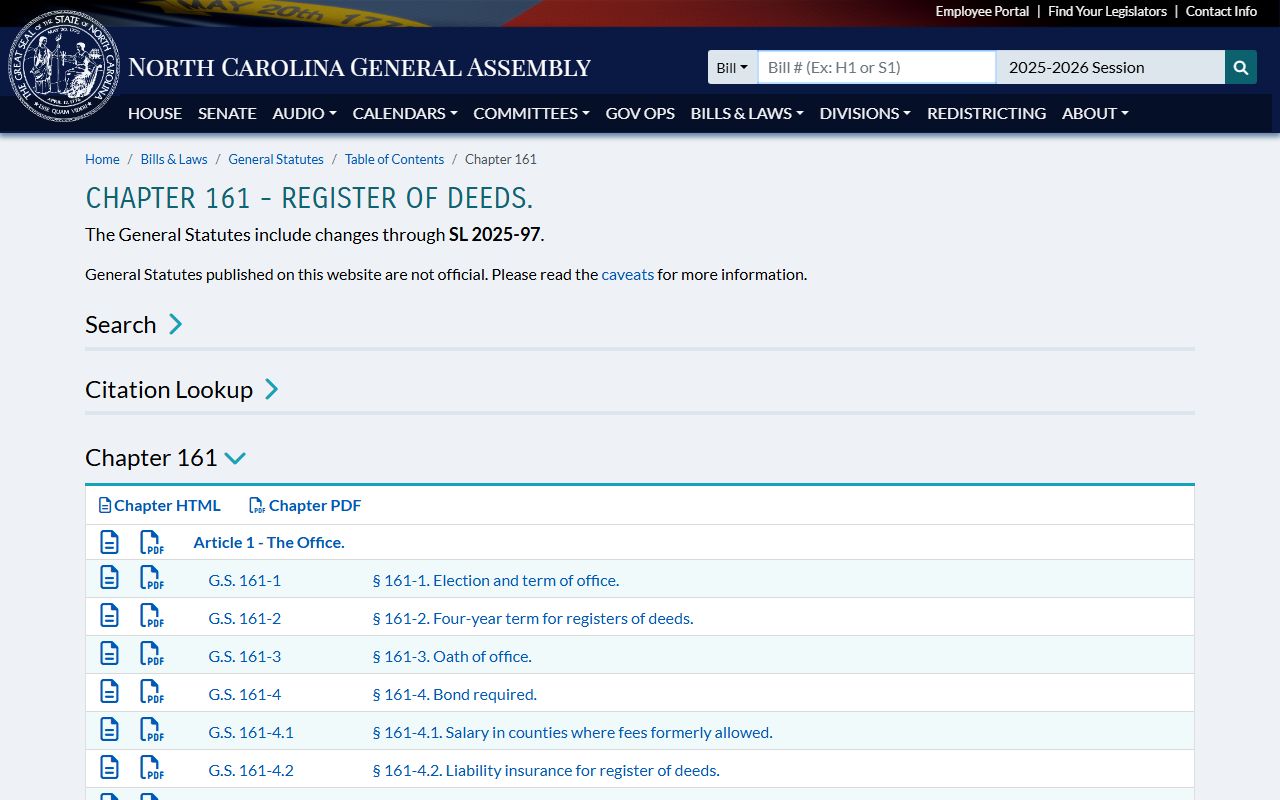
These statutes govern how documents are recorded in Davie County and across the state.
Davie County Title Research
Title research in Davie County builds a chain of ownership from the current deed back through prior transfers. Each link is verified. A thorough search covers deeds, deeds of trust, liens, judgments, easements, and covenants. The purpose is to confirm that the seller has clear title and that no hidden claims exist.
The Marketable Title Act limits how far back a title search must go. In most cases, a 30-year chain is sufficient. Claims older than that which were not re-recorded are generally extinguished. This simplifies the process for buyers and lenders in Davie County and reduces the risk of old claims disrupting a transaction.
For older records, the North Carolina State Archives holds historical land grants and early documents. Since Davie County was carved from Rowan County in 1836, records for parcels that predate the split are held by Rowan County or the state archives.
The State Archives is an important resource for tracing older Davie County land records.
Additional Davie County Resources
The Davie County tax office maintains assessed values and payment records for every parcel in the county. Tax records complement the deed records held at the Register of Deeds. They show what each property is worth for tax purposes and whether the taxes are paid. Buyers often review both sets of records before completing a purchase.
The North Carolina Secretary of State maintains filings for business entities that may own real estate in Davie County. If a deed lists a corporation, LLC, or trust as a party, you can check the Secretary of State's website to confirm the entity's status and registered agent. This step is part of standard due diligence for commercial and investment property transactions.
Davie County's proximity to Winston-Salem has spurred residential growth in recent years. New subdivisions and housing developments are adding to the county's inventory of recorded plats and deeds. The Register of Deeds office processes these filings and keeps the public records current for anyone who needs access.
Note: For Davie County parcels that were part of Rowan County before 1836, check Rowan County records for the original deeds and transfers.