
Cumberland County Property Records Access
Cumberland County property records are managed by the Register of Deeds in Fayetteville, North Carolina. Formed in 1754 from Bladen County, Cumberland County holds extensive real estate records spanning more than two centuries. The Register of Deeds office records deeds, deeds of trust, liens, plats, and other land instruments. Online access is available for searching these property records. Residents, title professionals, and the general public can search Cumberland County records to verify ownership, check liens, or trace historical land transfers in one of North Carolina's largest counties.
Cumberland County Quick Facts
Cumberland County Register of Deeds
The Cumberland County Register of Deeds office is located in Fayetteville. The office is open Monday through Friday, 8 AM to 5 PM. You can reach them by phone at 910-678-7775. Staff record and index all land-related documents for the county. These include warranty deeds, quitclaim deeds, deeds of trust, liens, plats, and maps.
Cumberland County was formed in 1754 from Bladen County. That gives the office more than 270 years of recorded property history. Fayetteville, the county seat, is also home to Fort Liberty, one of the largest military installations in the world. The military presence affects the local real estate market. Frequent transfers of property among military families generate a high volume of deed recordings each year.
The Cumberland County Register of Deeds website provides online access to recorded documents. You can search by name, book and page, or instrument number. The screenshot below shows the Cumberland County Register of Deeds website.
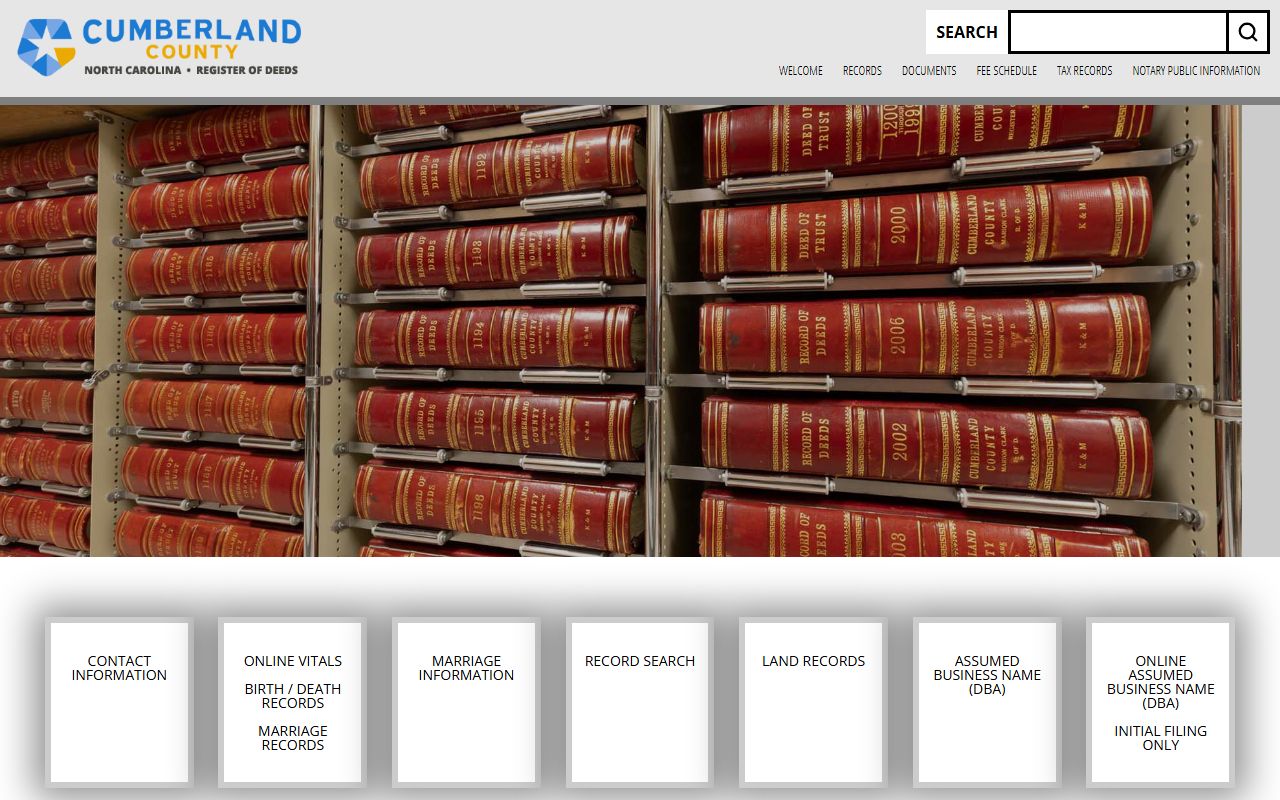
This is the main online portal for accessing Cumberland County property records.
The office also provides passport services and records DD-214 military discharge documents at no charge. These additional services make the Cumberland County Register of Deeds one of the busiest in the state.
Searching Cumberland County Property Records
Cumberland County offers online access to property records through its website. The search tools let you look up deeds and other documents from your home or office. You can search by owner name, parcel number, or document reference. Results show the document type, recording date, and names of the parties involved.
For in-person searches, the Register of Deeds office in Fayetteville maintains grantor and grantee indexes. The grantor index lists those who have transferred property. The grantee index lists those who received it. These indexes are the backbone of any title search in Cumberland County. Staff members can assist with searches and provide copies of recorded documents.
When using the online system, try different name variations if your first search returns no results. Middle initials, maiden names, and spelling differences can all affect what the system returns. For the most complete search, check both the grantor and grantee indexes. Under N.C.G.S. Chapter 161, the Register of Deeds must keep these indexes accurate and current.
Note: Cumberland County's online records may not include all historical documents, especially those from the earliest decades of the county's existence.
Cumberland County Deed Types
Cumberland County property records include several types of instruments. Warranty deeds are the most common. They transfer full ownership and guarantee clear title. The grantor warrants that no hidden claims, liens, or encumbrances exist. Quitclaim deeds transfer only the interest the grantor holds. They make no promises about the condition of the title. Special warranty deeds offer limited protection, covering only the period during which the grantor owned the property.
Deeds of trust are recorded in Cumberland County whenever a lender finances a real estate purchase. North Carolina uses deeds of trust rather than mortgages. Under N.C.G.S. Chapter 45, the borrower transfers the property to a trustee who holds it as collateral. When the loan is repaid, the lender records a cancellation at the Register of Deeds. If the borrower defaults, the trustee can sell the property under the power of sale clause.
Liens are another important category. Tax liens attach to properties with unpaid taxes. Mechanic's liens protect contractors. Judgment liens result from court decisions. All liens remain on the Cumberland County records until they are released or satisfied.
Recording Documents in Cumberland County
To record a document in Cumberland County, it must meet the requirements of N.C.G.S. Chapter 47. The document must be signed by the grantor and notarized. The grantor's name must match what appears in the prior recorded deed. A return address must be on the first page. Documents that do not meet these requirements will be returned.
Cumberland County charges recording fees for each instrument filed. These fees cover the cost of processing and indexing. The North Carolina excise tax on real estate transfers is collected at the time of recording. This tax is one dollar per five hundred dollars of the sale price under N.C.G.S. Chapter 105. Both the recording fee and the excise tax must be paid before the document is accepted into the county records.
Given the volume of transactions in Cumberland County, the Register of Deeds processes a high number of recordings each business day. The online system is updated regularly to reflect newly filed documents.
Title Research in Cumberland County
A title search in Cumberland County traces the ownership chain for a specific parcel. Starting with the current owner, the search works backward through each deed. Every transfer is verified. The search also checks for liens, easements, judgments, and restrictive covenants. A clear chain of title is required before most real estate transactions can close.
The Marketable Title Act helps simplify title research in Cumberland County. Under this law, a 30-year chain of title is generally sufficient. Claims older than 30 years that were not renewed or re-recorded are usually cut off. This protects modern buyers and lenders from ancient claims that might otherwise cloud the title.
Cumberland County's extensive history means some properties have very long chains of title. Records from the 1750s and 1760s may appear in the chain for older parcels. For these early documents, the North Carolina State Archives is a valuable resource. The archives hold land grants, colonial records, and early maps that can fill gaps in the county's record books.
The State Archives preserves historical land records from across the state, including Cumberland County.

Use the archives to trace Cumberland County property history back to the colonial era.
Note: Military families in Cumberland County should keep copies of their recorded deeds, as frequent relocations can make it harder to retrieve documents later.
Additional Cumberland County Services
The Cumberland County Register of Deeds offers services beyond property recording. The office processes passport applications for residents. It also records DD-214 military discharge papers at no charge. This service is especially important in Fayetteville given the large military community near Fort Liberty.
The county tax office maintains records of assessed property values and tax payments. These records are separate from the deed records but complement them. Buyers often check both the deed records and the tax records before purchasing a property in Cumberland County. Tax records show whether there are any unpaid taxes that could become liens against the property.
For statewide resources, the North Carolina Association of Register of Deeds provides a directory of all county offices. The North Carolina Secretary of State maintains business entity records that may relate to properties held by corporations or LLCs in Cumberland County.